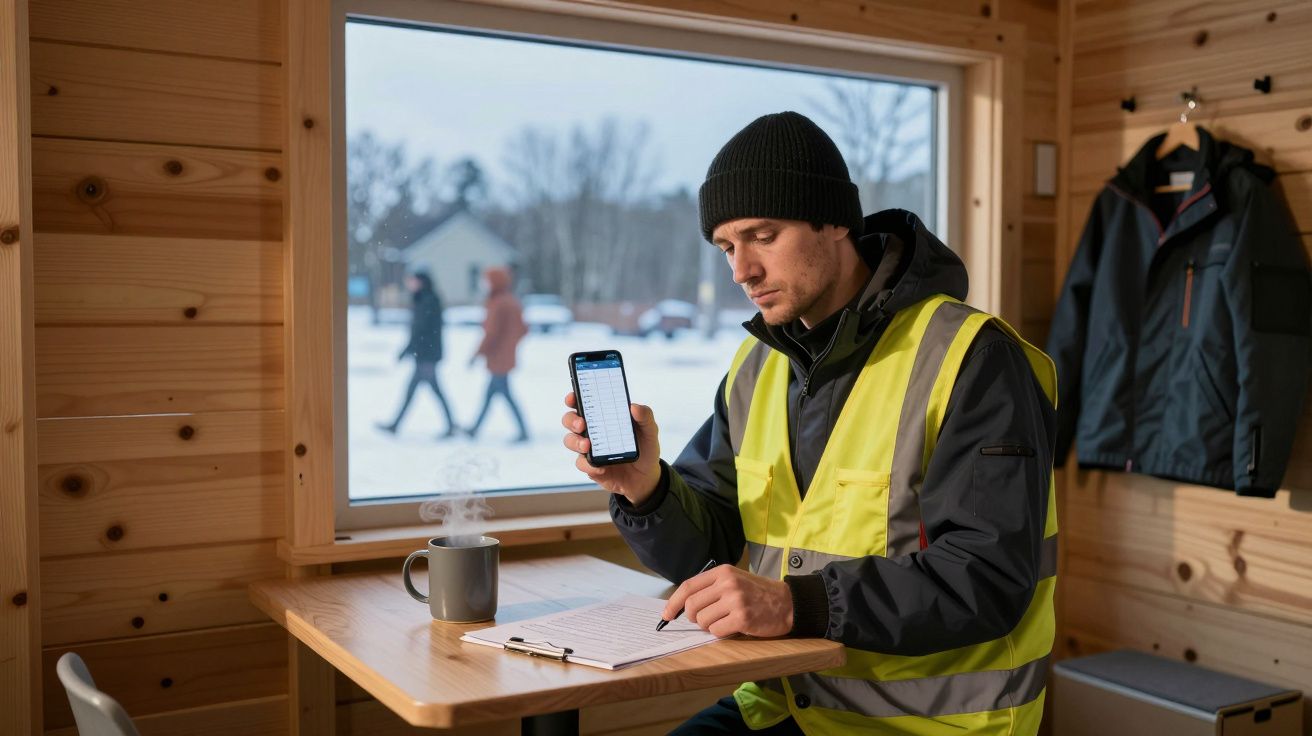
Seasonal heat stress doesn’t politely wait for summer. It builds into projects in spring and autumn, then shows up in January as frozen hands, fogged visors, sluggish kit, and a workforce moving more slowly than your programme ever allowed. By the time you’re blaming “winter” for lost days, postponed project decisions have already done the real damage: you locked in the wrong assumptions while the weather was still tolerable.
You see it first in the small failures that feel like bad luck. A site team stretching breaks because the welfare unit can’t keep up. A plant operator idling because visibility has dropped and the risk assessment wasn’t written for this. A manager quietly moving milestones “to be realistic”, knowing the dates were never realistic in the first place.
Winter doesn’t break systems. It reveals which ones were built on comfort.
The moment winter exposes the lie in your plan
On an early start, the kind where your breath hangs in the light, the programme looks fine on paper. Then the day begins to drag. Tasks that “should” take two hours take three, because people can’t warm up properly, tools are stiff, access is slower, and every movement has a safety tail.
The mistake is thinking this is purely a cold problem. It’s often a heat problem that was mishandled months earlier. Seasonal heat stress pushes teams to compress work in warm periods, skip recovery, and accept “temporary” shortcuts-only to discover in winter that the same teams are now brittle, under-resourced, and carrying fatigue like hidden debt.
If you’ve ever watched a schedule unravel in the first real cold snap, you know the feeling. It’s not drama. It’s physics and human limits arriving on time.
Seasonal heat stress: the summer tax you pay in winter
Seasonal heat stress is what happens when heat, humidity, radiant sun, workload, PPE, and poor recovery combine to strain the body over days and weeks. In construction, logistics, maintenance, and utilities, it isn’t just “a hot day”. It’s a performance and safety tax that quietly changes what your workforce can sustainably deliver.
Here’s the bit planners miss: heat stress doesn’t vanish when the temperature drops. It leaves a trail-fatigue, dehydration habits, reduced sleep during long bright evenings, higher injury risk, and a culture of “push through”. When winter arrives, you’re not starting from neutral. You’re starting from whatever summer took out of people and never got paid back.
You can feel it in the way the site moves. More minor errors. More near misses. More time spent redoing small things that should have been straightforward. Winter gets the blame, but summer set the conditions.
The hidden role of postponed project decisions
Most programmes don’t fail because someone made one huge, dramatic error. They fail because a handful of decisions were postponed until “we know more”.
- “We’ll finalise the welfare upgrade later.”
- “We’ll lock the sequencing once the subcontractor confirms availability.”
- “We’ll revisit the shift pattern after summer.”
- “We’ll deal with ventilation once the temporary works are in.”
Each delay feels rational in the moment. Then the season turns, lead times harden, and suddenly you’re making winter-critical choices with no room left. Postponed project decisions are rarely neutral; they quietly choose the default, and the default is usually “do nothing until it hurts”.
And winter is very good at making it hurt.
What “winter problems” usually are, in plain terms
When people say winter broke the project, they’re often describing a predictable chain reaction:
- The workforce is slower because warm-up time, PPE layers, and cold-related dexterity loss weren’t built into task durations.
- Access and logistics choke because daylight, ground conditions, and visibility weren’t planned as constraints.
- Plant and temporary systems underperform because they were sized for average conditions, not seasonal extremes.
- Quality slips because curing, drying, and inspection windows change, but the plan doesn’t.
None of this is mysterious. The mystery is why it wasn’t priced, programmed, and resourced when you still had choices.
A better question to ask in October
Instead of “How do we survive winter?”, ask: What assumptions are we making today that winter will punish later?
Then do the unglamorous audit. The same way a tiny knot changes how a shoe holds your heel, a few targeted adjustments change how a project holds its people and its schedule.
Start here:
- Capacity: Are you assuming summer productivity rates will hold through shorter days and slower starts?
- Recovery: Did you actually reduce load after heatwaves, or just celebrate “getting through it”?
- Controls: Are your welfare, rest, hydration, and supervision controls seasonal-or just generic?
- Procurement: What winter-critical items still sit in “TBC”, and what are the lead times now?
- Sequencing: Which tasks become fragile under cold, wet, or low light, and what’s the alternative path?
If you can’t answer quickly, you’re not late yet-but you are on the clock.
The simple fixes that prevent the seasonal whiplash
This isn’t about writing a thicker method statement. It’s about aligning the project to human performance across seasons, not just ideal days.
A few moves that usually pay back fast:
- Programme with seasonal productivity, not optimism. Build in realistic warm-up, briefing, and weather contingency that reflects your actual site.
- Treat heat stress as a cumulative exposure. Track it, talk about it, and plan recovery like you would for noise or vibration.
- Bring forward the “boring” decisions. Welfare capacity, drying/curing strategy, lighting, access, de-icing, temporary heating-decide while suppliers still have options.
- Design work packages for flexibility. Have a viable indoor/covered task list ready so poor conditions don’t equal lost days.
- Set thresholds in advance. Define when you slow down, when you stop, and who calls it-before a bad morning forces a rushed call.
The goal isn’t toughness. It’s stability.
Beyond weather: what you’re really managing is trust
When winter reveals the mistake, it also reveals the culture. If teams think targets matter more than bodies, they will hide fatigue and push through heat stress until it becomes normal. Then, in winter, those same teams will stop believing the plan, because the plan never believed them.
A calm project in January often started with unexciting choices in July: pacing, recovery, realistic outputs, and decisions made early enough to matter. It’s not magic. It’s respect for constraints-thermal, seasonal, and human.
| What winter reveals | The earlier mistake | What to do next time |
|---|---|---|
| Slowdowns, rework, rising risk | Planned on perfect-day productivity | Use seasonal rates + weather contingency |
| Fatigued teams, more minor incidents | Heat stress treated as “just summer” | Track and manage cumulative exposure |
| Scrambling for kit and access solutions | Postponed project decisions | Pull winter-critical choices forward |
FAQ:
- How can seasonal heat stress affect a project months later? It drives cumulative fatigue, poorer recovery, and a “push through” culture, which reduces resilience; winter then exposes the weaker baseline through slower work and higher error rates.
- What are the most dangerous postponed project decisions going into winter? Welfare capacity, lighting, access/ground conditions, curing/drying strategy, temporary heating, and clear stop-work thresholds-because lead times and constraints tighten fast.
- Isn’t winter simply less productive no matter what you do? Yes, but the gap between “seasonally slower” and “chaotic” is planning: realistic task durations, flexible sequencing, and pre-decided controls.
- What’s one practical step a manager can take this week? Run a seasonal assumption check: list the top 10 tasks for the next 8 weeks and note what changes under cold, wet, low light-then adjust durations, resources, or sequence before the next cold snap.






Comments (0)
No comments yet. Be the first to comment!
Leave a Comment