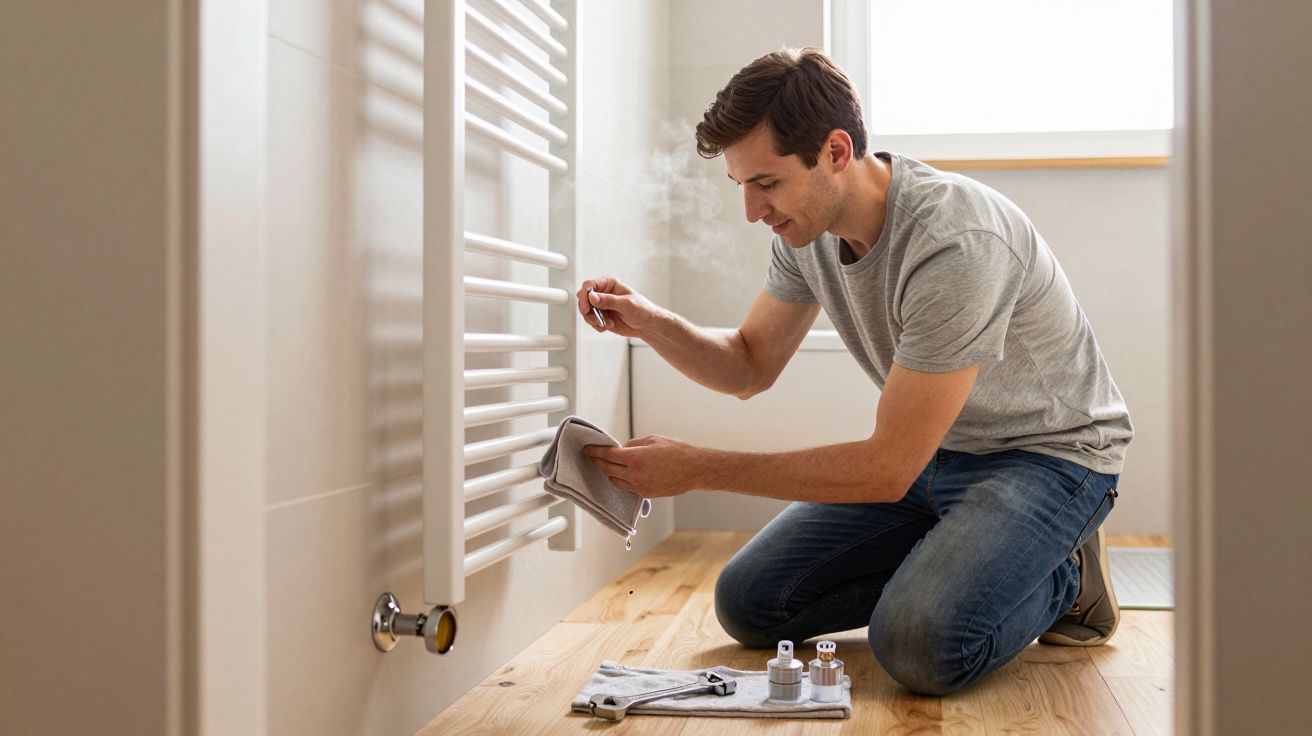
Bathroom refits look self-contained, but they often lean on the same hidden routes that feed central heating systems. A small pipework disruption behind a new wall, under a tiled floor, or near a moved radiator can leave the whole house with cold patches, noisy pipes, or a radiator that “dies” a week after the builders leave. It matters because the symptoms show up late, when access is hardest and the fix costs more than the original shortcut saved.
Most radiator failures after bathroom work aren’t mysterious faults in the radiator. They’re system problems: trapped air, debris, reversed flow, or a new restriction that your boiler and pump can’t easily push through.
The failure usually starts where you can’t see it
Bathrooms are pipe-dense. Even if you didn’t touch the boiler, the job may have involved lifting floorboards, moving a towel rail, altering a branch to feed a new mixer, or boxing-in old runs. Each of those changes can shift how water circulates through the rest of the system.
Common hidden changes include clipped pipes squeezed tighter than before, microbore accidentally kinked, or old gate valves “exercised” and then stuck half-shut. None of these stop heating outright on day one. They just make one part of the circuit the new weak link.
If one radiator now heats only at the top, only at the bottom, or only when others are off, assume the circulation path has changed before you blame the radiator.
Four ways bathroom work knocks a radiator out
1) Air finds a new high point
Alter pipe routes and you change where air collects. A slight rise under a new floor can become an air trap, especially if pipes were re-run to suit a shower tray or a new waste.
You’ll notice gurgling, a sloshing sound, or a radiator that warms then fades. Bleeding may help once, then the problem returns because the air isn’t just “in the radiator”; it’s gathering elsewhere and migrating.
2) Debris gets stirred up and blocks the narrow bits
Drain-downs, soldering, cutting, and refilling are all chances to introduce sludge, flux residue, and scale. That material moves until it hits the tightest passage: a thermostatic radiator valve (TRV), a lockshield, or the small waterways in modern radiators and towel rails.
A classic pattern is: bathroom completed, system refilled, one radiator now lukewarm while others are fine. The radiator isn’t broken; it’s being starved.
3) A valve ends up shut (or “mostly shut”)
Bathroom jobs often require isolating and reopening valves. A lockshield that was once balanced can be knocked, replaced, or reopened to a different position. TRV heads can be removed and refitted slightly skewed, leaving the pin stuck down.
This is why a radiator can fail in silence. No leaks, no air, no drama-just no flow.
4) Flow and return get swapped on a towel rail or radiator
Many towel radiators are more sensitive to which side is flow and which is return, particularly if they have an internal diverter. If the connections are reversed during a re-plumb, the rail may heat poorly and, worse, it can upset circulation on that branch.
The homeowner sees the casualty as “the cold bedroom radiator”. The cause can be a bathroom rail that’s now behaving like a restriction.
The symptoms tell you which fault you’ve bought
Use the behaviour, not the guesswork. Most post-project issues sit in a small set of patterns.
| What you notice | What it often points to | First check |
|---|---|---|
| Top hot, bottom cold | Sludge/blocked valve | TRV/lockshield, flush/filter |
| Bottom hot, top cold | Air trap | Bleed, then check pipe gradients |
| Heats only when others are off | Balance/partial restriction | Lockshields, kinked pipe, pump head |
| No heat at all, pipes cold | Closed/stuck valve | TRV pin, lockshield position |
Quick checks you can do before calling anyone out
Start with the simple, reversible moves. Don’t keep “tweaking” every valve in the house; that can mask the real issue and wreck balancing.
- Bleed the affected radiator and note whether air actually comes out or it’s just water.
- Feel the pipes at the radiator: are both cold, one hot/one cold, or both warm but the panel cold?
- Check the TRV pin: remove the head and gently press the pin; it should spring back.
- Confirm lockshield position: count turns to closed, then reopen to the previous setting if you know it.
- Listen for pump strain: if the boiler runs but circulation sounds weak after a refill, the system may need proper venting and balancing.
If the bathroom was refilled without inhibitor, or the water came out black during drain-down, assume debris is part of the story.
What a proper fix looks like (and why “just bleed it” often isn’t enough)
Engineers tend to solve this by treating the system, not the single radiator. That can include cleaning a blocked valve, powerflushing a problem circuit, fitting a magnetic filter, or rebalancing flows so the nearest radiators don’t steal all the heat.
In newer setups, it may also mean checking whether a new towel rail has been piped in a way that creates a bypass or a dead leg. A neat bathroom finish can hide a messy hydraulic layout.
The goal is stable circulation: hot water out, cooler water back, and no part of the loop acting like a trap, a choke, or a shortcut.
How to prevent it on the next project
Most failures are preventable with a few habits that good plumbers treat as standard.
- Protect the system during works: cap open pipes, minimise drain-down time, and avoid leaving pipe ends exposed.
- Flush the altered circuit before reconnecting sensitive valves and rails.
- Dose with inhibitor on refill and document what was added.
- Photograph pipe runs before boxing-in, including valve locations and which side is flow/return.
- Plan access: serviceable valves and filters beat “sealed forever” boxing.
If your bathroom installer doesn’t normally work on heating, insist that someone who does signs off the final fill, vent, and balance. That hour is cheaper than chasing cold rooms through winter.




Comments (0)
No comments yet. Be the first to comment!
Leave a Comment