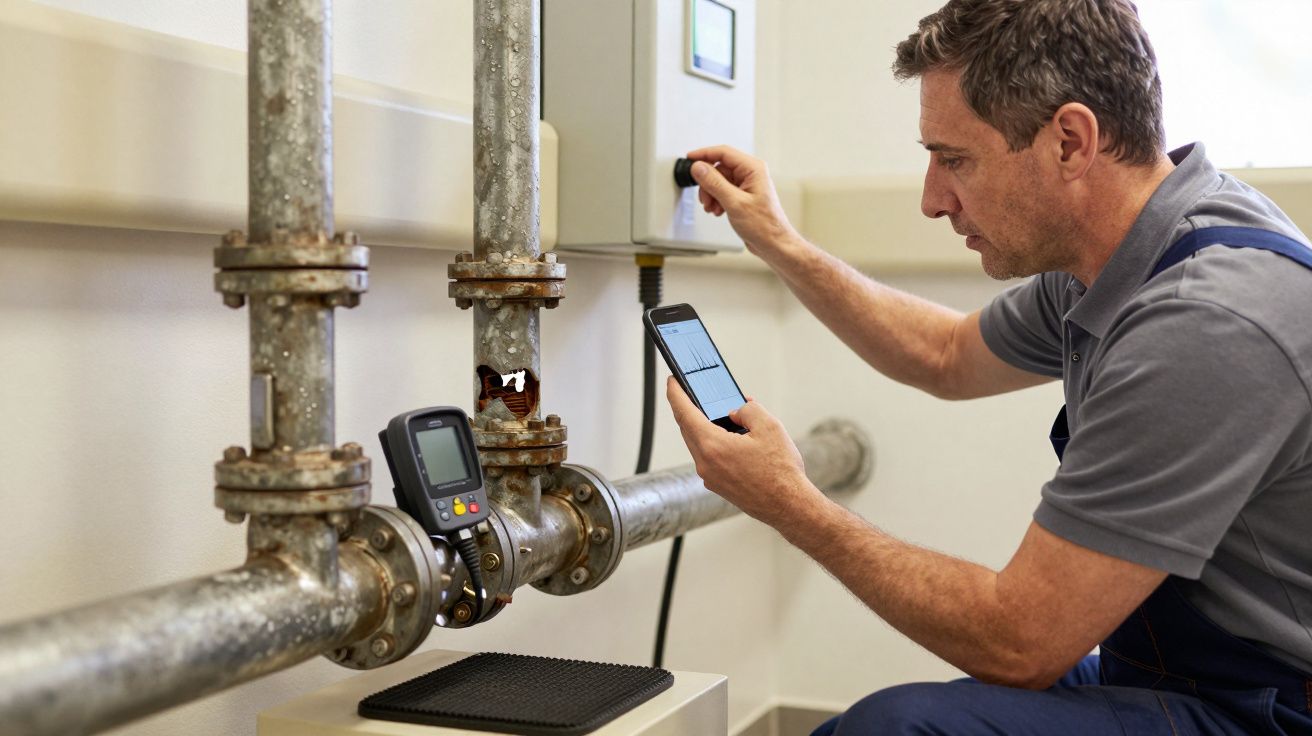
It often starts with a drawing that looks perfectly sensible on screen: new plant, new controls, new duty points. Then the first pressure test hits legacy pipework and a pressure shock ripples through bends, tees and old joints that have “always been fine”. Suddenly the project isn’t failing on design ambition-it’s failing on what it’s connected to, and the cost lands on the people who inherit the risk.
Most modern upgrades don’t break systems by being wrong. They break them by being fast, stiff and unforgiving in a network that was built for slower changes, softer starts and a bit of leakage that nobody wrote down.
The uncomfortable truth: old pipework remembers everything
Legacy pipework is not just “old pipe”. It’s a record of previous repairs, water chemistry, historic operating habits and thousands of tiny stress cycles. When you change the duty-higher flow, tighter control, different temperatures-you stop working with the drawing and start working with history.
That’s why two identical-looking sites behave differently. One has a margin you didn’t know existed. The other is already running on borrowed time, and your upgrade simply cashes the cheque.
The pipe didn’t suddenly become bad. Your project simply moved the goalposts.
Where modern projects usually go wrong
The failure pattern is remarkably consistent. Not dramatic negligence-just small, reasonable decisions stacking up.
Common triggers include:
- Variable-speed drives ramping too aggressively compared with the old fixed-speed regime
- Fast-acting valves (or control loops tuned “too well”) that create sharp transients
- New pumps sized for growth without checking what the network can absorb
- Isolation strategies that change flow paths and expose dead legs to live pressure
- “Like-for-like” replacements that are only like-for-like on paper, not in stiffness or friction losses
You can install premium equipment and still create a system that behaves worse, because the network dynamics have changed.
Pressure shock: the quiet project killer
Pressure shock is what happens when you change momentum faster than the water (or other fluid) can settle. In practical terms, it’s the slam when a valve closes quickly, the kick when a pump starts hard, or the rebound when a non-return valve chatters.
In legacy pipework, that shock has nowhere to go except into:
- fatigued threaded joints and unions
- old gaskets that have taken a permanent set
- corroded wall thickness you can’t see
- supports that were “good enough” until loads started cycling harder
The worst part is that the first sign is often indirect. A “random” leak. A recurring air problem. A strange rattle at 3am. Then the call-out becomes routine.
The myths that keep pressure shock alive
- “We’re still within design pressure.” Transients can exceed static design pressure locally and briefly-long enough to do damage.
- “It’s only water.” Water is incompressible enough to transmit shock extremely efficiently.
- “The kit is new, so it’s safer.” New kit can switch faster and tighter, which is exactly the problem.
The mismatch nobody budgets for: modern control meets old tolerance
Older systems often relied on “softness” without naming it. Pumps coasted. Valves took their time. Small leaks bled energy. Operators compensated by feel.
Modern projects remove that softness:
- VSDs hold pressure precisely, so spikes don’t dissipate as easily.
- Control valves react in seconds, not minutes.
- New pipe sections are stiffer, so movement shifts to the weakest remaining parts.
- Instrumentation reveals issues, but also drives more active control that can create new instability.
That’s how you get a site that is technically better controlled and operationally more fragile.
What to look for before you touch anything
You don’t need a PhD in transients to avoid the common traps. You need a pre-upgrade reality check focused on behaviour, not just capacity.
A useful on-site checklist:
- Ask where leaks “always” happen and what gets tightened regularly
- Listen for non-return valve chatter and note when it occurs
- Review start/stop sequences and how often pumps cycle in a day
- Check pipe supports, anchors and any evidence of rubbing or fretting
- Compare as-built routing to drawings-especially tie-ins and old bypasses
- Confirm what actually closes quickly (actuators, solenoids, trip valves)
If people say “it bangs sometimes but it’s normal”, treat that as a design input.
The fixes that stop projects failing the moment they go live
Most mitigations are not glamorous, but they’re cheaper than emergency repairs and reputational damage.
Practical options include:
- Slower ramp rates on drives and staged pump starts
- Valve closure profiles that avoid sudden cut-offs (or adding damping)
- Proper surge protection: accumulators, surge vessels, air chambers where appropriate
- Non-return valves selected for dynamic performance, not just diameter
- Pressure logging during commissioning to see what the system actually does
- Replacing or re-rating the weakest legacy sections deliberately, not reactively
Commissioning matters here. A “working” system can still be a damaging system if the transient profile is ugly.
A short story every project team recognises
A hospital swaps to high-efficiency pumps and adds smarter pressure control to stabilise wards at peak demand. It performs beautifully-until the first weekend when demand drops, valves close down, and the new control loop hunts. The network starts seeing rapid micro-swings, and a thirty-year-old joint in a ceiling void begins to weep.
Nobody links the leak to the control strategy at first. The joint gets repaired twice. Only when someone logs pressure at the riser do they see the spikes, small but relentless. The kit is “right”. The legacy pipework is simply being asked to live in a different world.
A simple way to explain it to stakeholders
If you need one sentence that lands: modern projects fail old pipework because they increase the rate of change.
Not always higher pressure. Not always higher flow. Just faster transitions, tighter control and sharper events-exactly the conditions where fatigue, corrosion and historic repairs stop being “background” and become the limiting factor.
A compact risk map (what changes, what it breaks)
| Project change | Typical consequence | What to verify |
|---|---|---|
| Faster valve/pump actions | Pressure shock and vibration | Transient logging, valve dynamics |
| Higher duty or new flow paths | Erosion, noise, weak-point exposure | Wall thickness, supports, tie-ins |
| Tighter control loops | Hunting and cycling fatigue | Tuning, minimum run times |
The takeaway: design for the network you have, not the one you wish you had
Treat legacy pipework as an asset with a personality, not a passive backdrop. If your upgrade changes speed, stiffness or control response, assume you’ve changed the loads-even if the steady-state numbers look fine.
The projects that succeed don’t just modernise equipment. They modernise the way the old network is allowed to experience change.
FAQ:
- Can pressure shock really cause leaks even if pressure stays “within limits”? Yes. Short transients can create local peak loads and repeated cycling that fatigue old joints and gaskets.
- Is this only a problem when adding VSDs? No. Any fast-acting valve, new control strategy, or altered start/stop sequence can introduce damaging transients.
- Do we need a full surge analysis on every upgrade? Not always, but you should at least log pressure during commissioning and review valve/pump dynamics where the consequences are high.
- What’s the quickest win if we’re already seeing banging or rattling? Slow down closures/ramps, check non-return valve behaviour, and add temporary pressure logging to pinpoint when spikes occur.






Comments (0)
No comments yet. Be the first to comment!
Leave a Comment