It’s usually the phone call that gives it away: underfloor heating has “stopped working”, the floor feels patchy, and the boiler seems to be doing all the effort for none of the comfort. In a lot of homes, those symptoms aren’t born at the manifold or the screed - they’re the delayed echo of system design errors made months earlier, when the drawings looked tidy and the room-by-room numbers felt like guesswork. Get the design right and underfloor heating is quiet, even, and cheap to run; get it wrong and every winter becomes a troubleshooting season.
You can replace actuators, flush loops, and argue with thermostats for weeks. If the heat loss is off, the flow temperatures are wrong, or the zoning is fighting the building, the floor is simply doing what it was asked to do.
What “failure” actually means in real homes
Most underfloor heating “failures” aren’t total breakdowns. They’re performance failures: it warms slowly, never quite hits setpoint, overshoots, or forces the heat source to run hotter than it should.
That’s why the same install can look fine on day one and feel dreadful in January. Under low demand, design weaknesses hide; under peak load, they show up as cold spots, high bills, and rooms that only feel comfortable when you crank everything up.
A system can be mechanically perfect and still fail the comfort test if the design targets were wrong.
Where design goes wrong (and how it shows up later)
1) Heat loss is guessed, not calculated
The most common starting mistake is treating heat loss like a rule of thumb. Room size gets multiplied by a generic watts-per-square-metre figure, insulation gets assumed, and “it’ll be fine” sneaks in where numbers should be.
What you see later:
- The coldest room (often a north-facing extension or big-glazed kitchen) never catches up.
- Thermostats hit target only when flow temperature is pushed higher than planned.
- The system runs for long hours with little improvement.
What helps: a proper room-by-room heat loss calculation, including ventilation and actual fabric values. If the house is being renovated, base it on what will be built, not what you hope will be built.
2) Pipe spacing and outputs don’t match the room’s demand
Bathrooms and glazed spaces often need tighter pipe centres to deliver enough heat at sensible temperatures. If spacing is too wide, you end up chasing comfort by raising flow temperature for the whole system, which punishes efficiency.
What you see later:
- “Stripy” warmth underfoot.
- Warm hallways and chilly perimeter zones by patio doors.
- A heat pump that loses efficiency because it’s forced into higher temperatures.
What helps: design for required output at the intended flow temperature, then set pipe spacing and floor build-up accordingly. The floor is the emitter; treat it like one.
3) Flow temperature is designed for the wrong heat source
Underfloor heating loves low, steady temperatures. Many designs quietly assume boiler-style temperatures, then try to “mix down” at the manifold without checking whether the heat source can (or should) operate that way.
What you see later:
- A condensing boiler that rarely condenses.
- A heat pump that short-cycles or runs inefficiently.
- Endless tinkering with blending valves and weather compensation.
What helps: pick a design flow temperature that suits the heat source, then verify the floor can meet room loads at that temperature. If it can’t, fix the emitter design (spacing, build-up, supplementary heating) rather than cooking the whole system.
4) Loops are too long, or the manifold layout is awkward
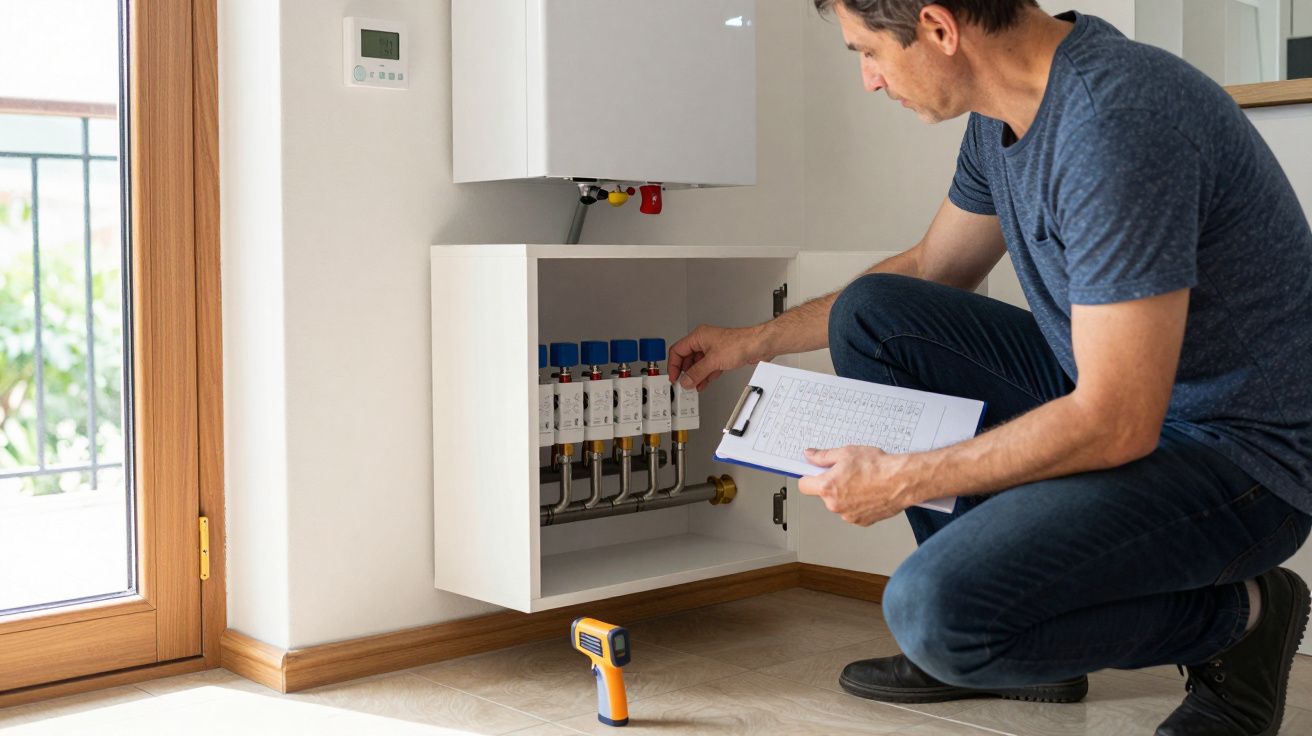
Hydraulics matter more than people expect. Overlong circuits create high pressure drops, starve flow, and make balancing a misery. Poor manifold positioning can force long runs of poorly insulated pipework, adding loss where you don’t want it.
What you see later:
- One loop stays lukewarm while others are hot.
- Balancing “works” until doors close, seasons change, or thermostats start cycling.
- Pump noise, high pump speeds, and a system that feels temperamental.
What helps: keep loops within sensible lengths, group similar loads on the same manifold, and plan manifold locations around pipe runs and service access - not just aesthetics.
5) Zoning fights the building’s thermal behaviour
A highly insulated slab wants to drift gently; a lightweight suspended floor responds faster. Design that ignores that difference often creates control logic that constantly over-corrects.
What you see later:
- Rooms overshoot after a sunny afternoon.
- The heating is “on” but you don’t feel change for hours.
- Family members keep raising setpoints because they want speed, not more heat.
What helps: match controls to thermal mass. Use weather compensation where possible, avoid aggressive setbacks on heavy floors, and zone by use and exposure rather than by “one thermostat per room” as a default.
A quick design-first check before you blame the floor
If you’re dealing with an underperforming system, ask questions that point upstream:
- What is each room’s calculated heat loss at design conditions?
- What flow temperature was the system designed to run at, and why?
- Are pipe spacings and floor constructions consistent with the required outputs?
- What are the loop lengths and pressure drops, and was the pump selected accordingly?
- How are zones grouped, and does the control strategy suit the floor’s thermal mass?
If you can’t get clear answers, you’re often looking at a design gap, not an installation defect.
The “quiet” framework that makes underfloor heating reliable
Good designs tend to share the same habits. They’re dull on paper and brilliant in winter.
- Prove the load. Heat loss first, then emitter design, then controls.
- Protect low temperatures. Don’t fix output problems by raising flow temperature system-wide.
- Design hydraulics, not just layouts. Loop lengths, balancing range, pump selection, and manifold placement.
- Control for reality. Slow systems need steady logic; fast systems need restraint.
Comfort is engineered. The floor only delivers what the design asked it to deliver.
Signals your “floor problem” is actually a design problem
- The system only feels acceptable at unusually high flow temperatures.
- The coldest room is always the same room, every year.
- Balancing never seems to “stick”.
- A heat pump struggles, cycles, or can’t maintain target temperatures during cold spells.
- You keep changing thermostats, actuators, or apps - and nothing fundamentally improves.
FAQ:
- Why does my underfloor heating take ages to warm up? Some systems are naturally slow (especially thick screeds), but excessive warm-up time can also point to low flow rates, poor zoning strategy, or an emitter design that can’t meet the room’s heat loss at the chosen flow temperature.
- Can I just increase the flow temperature to fix cold rooms? You can, but it often hides the real issue and increases running costs. If one or two rooms are short on output, it’s usually better to review heat loss, pipe spacing, floor build-up, or add targeted supplementary heat.
- Is patchy warmth always a fault with the pipes? Not always. Patchiness can come from wide pipe centres, air or balancing issues, or floor coverings with high thermal resistance. The pattern and the room type often point back to design choices.
- Does underfloor heating work well with heat pumps? Yes, when the design is built around low flow temperatures and steady operation. Many problems come from designs that assume boiler temperatures, then retrofit heat pumps without rechecking outputs and controls.




Comments (0)
No comments yet. Be the first to comment!
Leave a Comment