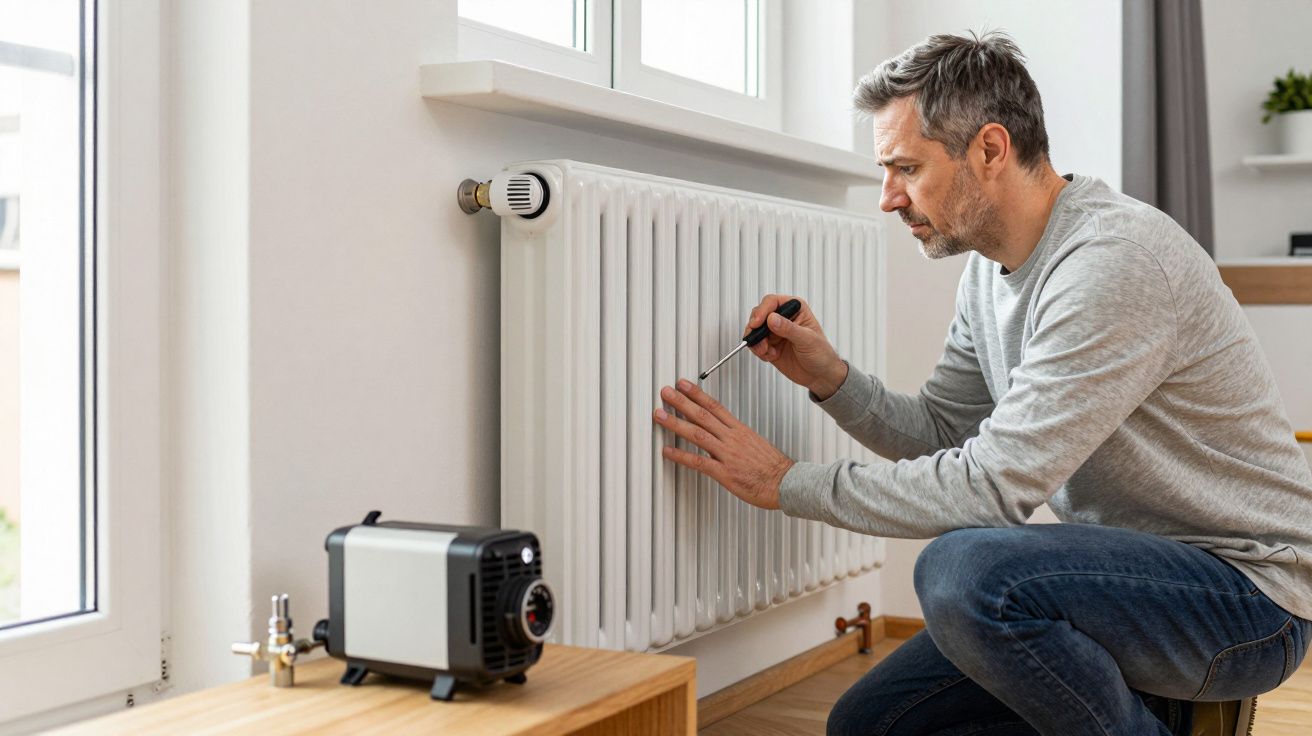
You don’t usually think about central heating pumps until the house feels “off” - a bedroom that never quite warms up, a radiator that hisses, a boiler that sounds busier than it should. Quite often the culprit isn’t a dramatic failure, but flow rate errors: water moving too fast, too slow, or simply not the way your system was designed for. A mis-sized pump can quietly waste energy, create noise, and make balancing feel like a never-ending DIY loop.
The frustrating part is that a pump can be brand new and still wrong for the job. Size here isn’t just “bigger is better”; it’s matching head (pressure) and flow to your pipework, radiators (or underfloor), and control setup. If your heating has a personality shift after a refurb, boiler swap, or extension, it’s worth reading the signs before you start bleeding radiators for the tenth time.
The quick idea: what “mis-sized” really looks like
A pump that’s too small struggles to push hot water around the whole circuit. A pump that’s too big shoves water through so aggressively that you get noise, unstable control, and poor heat transfer. Either way, comfort drops and your system starts behaving like it’s temperamental, when really it’s just mismatched.
Most of the symptoms below are subtle because the heating still technically “works”. It just works in a way that nags at you every cold morning.
Top signs your pump is too big (over-pumping)
1) You get rushing, whooshing, or “waterfall” sounds in pipes and radiators
A gentle hum is normal. A constant whoosh, especially when thermostatic radiator valves (TRVs) start closing, often points to excessive flow. You’re basically forcing water through partially restricted valves and tight bends.
If the noise changes room-to-room as TRVs react, that’s another clue: the pump is overpowering the system as it modulates.
2) Radiators feel hot near the valve, cooler elsewhere - even after balancing
When water races through a radiator, it doesn’t linger long enough to dump its heat. You can end up with the first part of the panel scorching and the far side oddly underwhelming, even though the system pressure looks fine.
This is one of those classic “it’s hot but it’s not warming the room” moments. It’s not always the pump, but over-pumping makes it more likely.
3) TRVs “hunt” and rooms swing from too warm to too cool
Overly high flow can make controls twitchy. A room warms quickly, the TRV snaps shut, pressure spikes elsewhere, another valve reacts, and you get a cycle of overshoot and correction.
The house never settles into that steady, boring warmth you actually want.
4) Your bypass valve is constantly doing the work (and you can sometimes hear it)
Many systems have an automatic bypass valve (ABV) to protect the boiler when zones close. If the pump is strong and several TRVs close, a lot of flow may dump through the bypass instead of going through emitters.
That means you’re circulating hot water in a short loop, which is great for noise and wear, and not so great for comfort.
Top signs your pump is too small (under-pumping)
5) Far radiators are lukewarm while near ones are fine
This is the classic “upstairs never gets properly hot” complaint. If the pump can’t overcome the resistance of the circuit (pipe length, fittings, valves, radiator paths), the easiest routes get the flow and the distant branches get what’s left.
Bleeding helps only if air is the problem. With under-pumping, you can bleed all day and still feel that imbalance.
6) Warm-up times get noticeably longer, especially in cold snaps
A correctly sized pump helps deliver design flow so radiators can output their rated heat. If flow is too low, heat delivery slows and recovery takes ages.
You might also notice the boiler running longer in a way that feels “busy”, yet rooms still lag behind.
7) Underfloor heating loops (if you have them) feel patchy
Underfloor circuits are long and resistance-heavy. If the pump serving them (or the primary pump feeding a manifold) is under-sized, some loops starve. Floors can feel warm in one area and oddly cool in another, even with the same setpoint.
This can get misdiagnosed as insulation or thermostat placement, when the real issue is simply not enough flow.
The tell-tale sign it’s a sizing issue (not just “air in the system”)
8) You keep chasing symptoms: bleed, rebalance, tweak speed… and it always comes back
Air causes noise and cold spots, but once properly purged it usually stays improved. A mis-sized pump creates a repeating pattern: you fix one room, another gets worse; you quieten one radiator, a different one starts hissing.
This is where flow rate errors show their face. The system is fighting itself, not just holding a bit of trapped air.
A quick, practical check you can do without special kit
Before you call anyone, you can gather useful clues in ten minutes:
- Put the heating on and listen: is it a low hum or a constant whoosh?
- Feel the radiator temperatures: are the nearest ones doing all the work?
- Note when the noise happens: only when TRVs close, or all the time?
- Check the pump setting (if accessible): many have 1–3 speeds or an “auto/adaptive” mode.
- Look for recent changes: new boiler, new zone valves, a removed header tank, extended pipework, added radiators.
If the pump has been turned up “to make it work better”, that’s not proof it’s right - it’s often a sign the system wasn’t matched or balanced after changes.
What usually causes mis-sizing in real homes
It’s rarely malice. It’s usually one of these:
- A boiler swap where the old pump choice got copied over without recalculating head/flow.
- A bigger pump fitted to “cure” cold radiators, masking a balancing or pipe restriction issue.
- System converted (open-vent to sealed, or added zones/UFH) but pump and bypass arrangement not updated.
- A modern high-efficiency pump replacing an older one, but left on the wrong control mode.
A pump is only one part of the hydraulics, but it has a loud way of telling you when it doesn’t belong.
When to get a heating engineer involved (and what to ask for)
If you recognise two or more signs above, it’s worth asking for a proper flow/head check rather than another round of bleeding. A good engineer can measure temperature differential, check bypass behaviour, and confirm whether the pump curve suits your system.
Ask specifically for: - Confirmation of required flow rate and estimated system head loss - Whether the pump is set correctly (fixed speed vs proportional pressure vs auto) - Whether an ABV is present and adjusted appropriately - Whether balancing has been done with realistic pump settings (not “maxed out”)
Because when the pump is right-sized, the whole house gets boring again - warm rooms, quiet pipes, and controls that stop acting like they’re in an argument.
FAQ:
- Can I just turn the pump down and see if it helps? If your pump has selectable speeds or an adaptive mode, reducing speed can reduce noise and improve stability. If distant radiators then go cold, that’s useful evidence of an underlying flow/head mismatch rather than a final fix.
- Does a bigger pump always heat the house faster? Not necessarily. Too much flow can reduce heat transfer at radiators and make controls unstable, so you can get noise and discomfort without better warmth.
- How do I know it’s the pump and not sludge or a blocked radiator? Blockages tend to affect specific radiators consistently, often with cold bottoms and hot tops. Mis-sizing tends to create system-wide patterns (noise, hunting TRVs, chronic imbalance) that shift as valves open and close.




Comments (0)
No comments yet. Be the first to comment!
Leave a Comment