Wet rooms are sold as the clean, modern answer to awkward bathrooms, but wet room installations can quietly fail weeks after the last tile is grouted. The cause is rarely “bad luck”; it’s usually predictable waterproofing mistakes that only show up once daily showers, heat, and movement start doing their slow work. If you’re planning one, supervising trades, or dealing with a damp smell you can’t explain, knowing the usual failure points saves money and mess.
A wet room can look flawless on day one. Then the first winter hits, a hairline crack appears at the wall junction, and water begins travelling where you can’t see it - under tiles, into timber, down to the ceiling below. It doesn’t flood. It just feeds mould, swells boards, and loosens finishes until something gives.
1) The fall is wrong (or it’s “flat enough”)
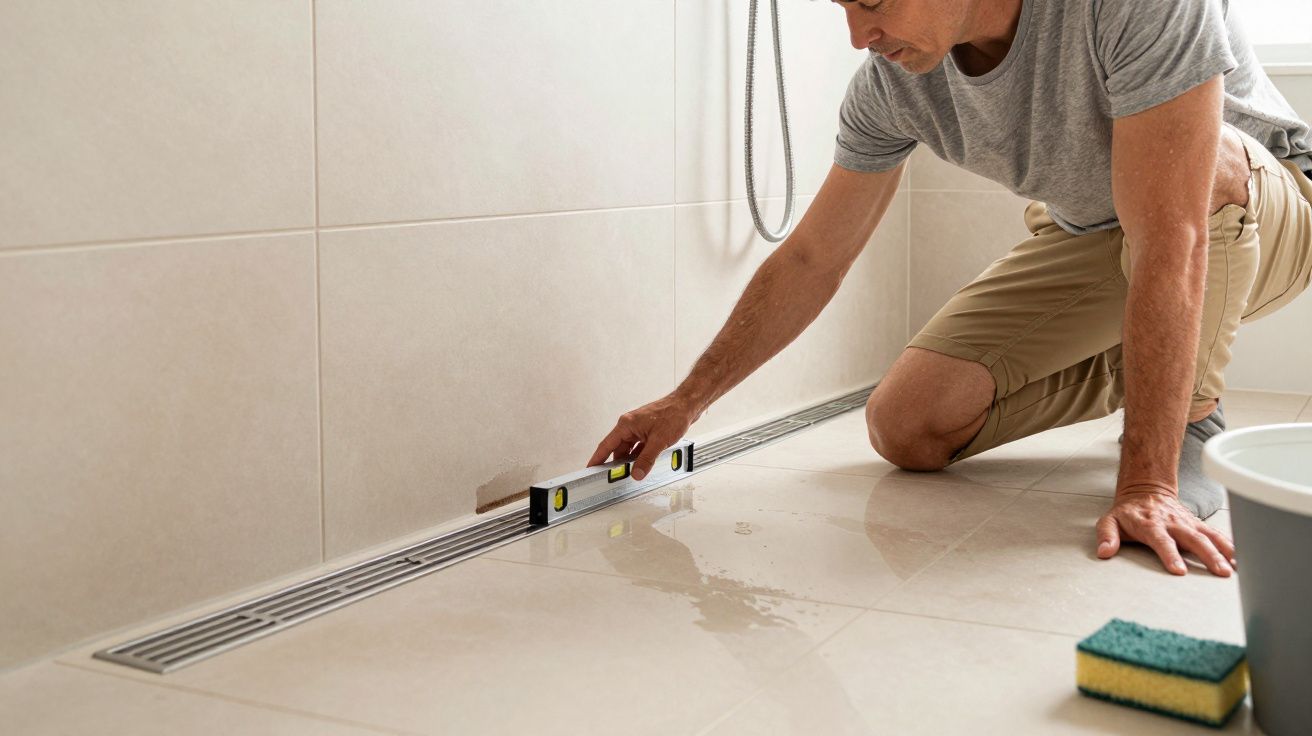
The most common failure is boring: the floor doesn’t actually fall to the drain properly. Installers might aim for a minimal gradient to make tiling easier, but water needs a reliable path or it will pond and creep into edges.
A puddle that sits after every shower isn’t just annoying. Standing water increases the time your grout, corners, and penetrations have to resist moisture - and they’re not designed to be bathtubs.
Watch for: - Water sitting around the drain or along one wall. - A “dry” corner that’s always darker. - A drain that gurgles because it’s fighting surface tension instead of receiving flow.
2) The waterproofing stops where the water doesn’t
People think of the wet area as “the bit under the shower”. Real life doesn’t respect that line. Water splashes, bounces off bodies, tracks on feet, and wicks sideways through grout.
A classic mistake is keeping tanking too low on walls or skipping it behind fixtures because it “won’t get wet”. The first time a handheld shower sprays sideways, that assumption gets tested.
“The leak wasn’t in the middle of the floor,” one fitter told me. “It was at the first tile up the wall, where no one bothered to continue the membrane.”
3) Corners, junctions, and changes of plane aren’t reinforced
The tile surface is decorative; the membrane is what keeps water out. Where the floor meets the wall, where one wall meets another, and where different materials join - those are movement points. Houses move. Timber expands. Screeds shrink. Even solid masonry shifts slightly with seasons.
If those junctions aren’t treated properly (tapes, compatible sealants, correct overlaps), you get tiny failures that behave like a zip slowly opening. Water doesn’t need a hole; it needs a pathway.
Typical weak spots: - Floor-to-wall perimeter - Niche corners - Doorway threshold (even in “doorless” wet rooms) - Under the drain flange
4) The drain is the problem, not the hero
A wet room drain assembly is a system: body, flange, clamping ring (if used), membrane interface, and grate height relative to tiles. When any part is incompatible or installed out of sequence, you create a perfect leak point right where the most water goes.
This is where “looks fine” becomes dangerous. A drain can appear neat while the membrane connection underneath is compromised, or the weep paths are blocked with adhesive.
Common drain failures after completion: - The grate sits slightly proud, causing water to skim away from it. - Tiles are cut too tight, leaving no allowance for movement. - The membrane isn’t bonded correctly to the drain flange.
5) “Waterproof” boards and backers are treated as waterproofing
Moisture-resistant boards are not the same as a continuous waterproof layer. They help, but they are not a replacement for correct tanking and detailing.
This failure shows up as swollen skirting areas, soft spots at the perimeter, or grout lines that start cracking in a pattern that looks like the room is “settling”. It is - but the water is accelerating it.
6) Grout and silicone are asked to do a membrane’s job
There’s a quiet lie that gets told on some jobs: “It’s fine - we’ll silicone it.” Silicone is a sealant, not a waterproofing strategy. Grout is porous. Both age, both can peel, and both are easy to cut accidentally during cleaning.
When the only thing stopping moisture is a bead of silicone at the perimeter, failure isn’t a surprise. It’s a schedule.
A good wet room assumes sealants will need maintenance and designs so that, if they degrade, water still can’t reach the structure.
7) No flood test, no proof, no baseline
Many wet room leaks are discovered after decoration, after occupation, after the ceiling below is painted. That’s when the repair becomes expensive and personal.
A proper flood test (done at the correct stage, for long enough, with the drain temporarily sealed) isn’t bureaucracy. It’s how you find the weak corner while everything is still accessible.
If you’re managing a project, ask for: - Photos of membrane coverage before tiling. - Product data showing compatibility (membrane + adhesive + drain). - Written confirmation of flood testing and results.
8) Ventilation is underestimated, so moisture becomes constant
Not every “wet room failure” is a leak. Some are a humidity problem that behaves like a leak: persistent condensation, mould returning at the ceiling line, paint blistering, and a musty smell that never leaves.
Wet rooms create more airborne moisture because the whole space is the shower zone. If extraction is weak, poorly ducted, or rarely used, the room stays damp long after the water is off - and materials start degrading faster.
A simple gut-check: if the mirror stays fogged for ages, the room is staying wet.
A quick diagnostic you can do without ripping up tiles
Look for patterns. Water damage usually tells a story in the same places because the same details fail.
- Check the perimeter line where floor meets wall for darkening, crumbling grout, or recurring mould.
- Press gently for movement in tiles near the drain and at corners.
- Sniff low: mustiness near the skirting line is more meaningful than a steamy smell at head height.
- If there’s a room below, look for staining that aligns with the doorway, drain, or perimeter - not the centre.
The good news: most failures are predictable
Wet rooms don’t fail because they’re a bad idea. They fail because the details that matter are hidden, easy to rush, and hard to “inspect” once tiled. If you treat the membrane, junctions, drain integration, and ventilation as the real project - and the tiles as the finish - you get a wet room that stays boring for years, which is exactly what you want.
| Failure point | What it causes | What to insist on |
|---|---|---|
| Poor falls to drain | Ponding, creeping moisture | Measured gradient, tidy drain set-out |
| Weak junction detailing | Hairline cracks, slow leaks | Reinforcement at corners and changes of plane |
| Drain/membrane mismatch | Leaks at highest flow point | Compatible system and correct sequence |
FAQ:
- How long does it take for a wet room leak to show up? Sometimes weeks, often months. Slow leaks travel under tiles and show as staining, smells, or loose tiles rather than obvious pooling.
- Can grout be the reason my wet room is leaking? Grout can contribute, but it usually isn’t the root cause. Most leaks come from failed detailing at corners, the drain connection, or missing/compromised membrane.
- Do I really need a flood test if the installer is experienced? Yes. Experience helps, but a flood test catches small defects before tiles hide them, and it gives you a clear baseline if problems arise later.
- Is mould always a sign the waterproofing has failed? Not always. It can be poor ventilation or persistent condensation. But mould recurring at the perimeter or low on walls can also indicate moisture getting behind finishes.
- What’s the single most common mistake in wet room installations? Getting the falls and the drain detail wrong. If water doesn’t consistently run to the drain, every other component is under more stress every day.






Comments (0)
No comments yet. Be the first to comment!
Leave a Comment