
You don’t notice a wet room layout until it goes wrong. The water doesn’t just “drain”; it chooses water flow paths across your floor, around your toilet, under your vanity, and straight towards whatever gap you forgot existed. In a shower room used every day, that one decision about where the water is allowed to travel becomes the difference between a space that feels effortless - and one that quietly stresses you out.
Picture the moment after a morning shower: towel in hand, you step out and there’s a thin sheet of water skimming towards the door. The grout looks darker in the corner that never quite dries. The mat is permanently damp. Nothing is dramatic enough to count as a disaster, but it’s never fully comfortable either.
That’s the trap with wet rooms. When they work, they feel like a boutique hotel. When they don’t, you spend years doing tiny compensations: squeegeeing, propping doors open, wiping skirting boards, wondering why it smells a bit “bathroom-y” even when it’s clean.
The decision most people think is about style (but isn’t)
Ask someone what matters in a wet room and they’ll point at the tiles. The niche. The brassware. The fancy drain.
The decision that changes everything is simpler: do you create a clear, intentional route for water to leave the room - or do you let the whole floor become the route? That comes down to zoning and falls, not aesthetics. A wet room is basically a controlled spill; your job is to control it.
If you leave water to “find its own way”, it will. It will find the lowest point, the easiest grout line, the doorway you wanted to keep dry, and the area with the least ventilation.
Water is obedient - just not to wishful thinking
Water doesn’t care about your floor tiles being “pretty level”. It responds to gradients you can barely see, and it keeps responding long after you’ve stopped looking.
A good wet room doesn’t rely on luck. It relies on predictable water flow paths:
- From shower head to floor.
- From floor to drain.
- From drain to waste.
- From everywhere else back to “dry enough” quickly.
The moment any part of that chain is vague, you get the classic symptoms: puddling at the threshold, damp grout at the edges, and that slow build-up of moisture in the places you never designed for it.
The quiet layout mistake: putting the drain where it looks best
Design drawings often place the drain where it’s least visually intrusive. In real life, the drain needs to sit where it can actually capture the most water with the least drama.
If your shower is on one end of the room and the drain sits politely in the middle “for balance”, you’ve just asked water to cross your entire floor twice a day. That means more wet surface area, more slippery moments, and more time spent waiting for the room to dry.
A layout that behaves tends to do the opposite: it shortens the distance between “water lands” and “water exits”. Less travel, less mess, less moisture load on the whole room.
The layout move that makes the room feel bigger (and drier)
This is where zoning earns its keep. Instead of treating the whole room as one wet plane, you create a clear “shower zone” and a clear “everything else zone”.
That usually means one of these:
- A fixed glass screen that stops spray from becoming a room-wide mist.
- A short return wall (even 300–600 mm can change everything).
- A slight change in floor plane (subtle, but intentional) that guides water back to the drain.
People worry this will make the room feel smaller. In practice, it often makes it feel calmer, because you’re not constantly negotiating dampness everywhere.
Falls: the boring detail with the biggest consequences
Most wet room regrets are basically fall regrets.
Too little fall and water lingers. Too much fall and the floor feels awkward underfoot, furniture doesn’t sit nicely, and you end up with weird tiling cuts that look “off” even if you can’t explain why.
Your installer can talk specifics, but as a homeowner your job is to insist on one thing: the fall must be designed around where water actually goes, not around the idea that it will “sort itself out”. If the shower is used daily, the fall should prioritise that zone first.
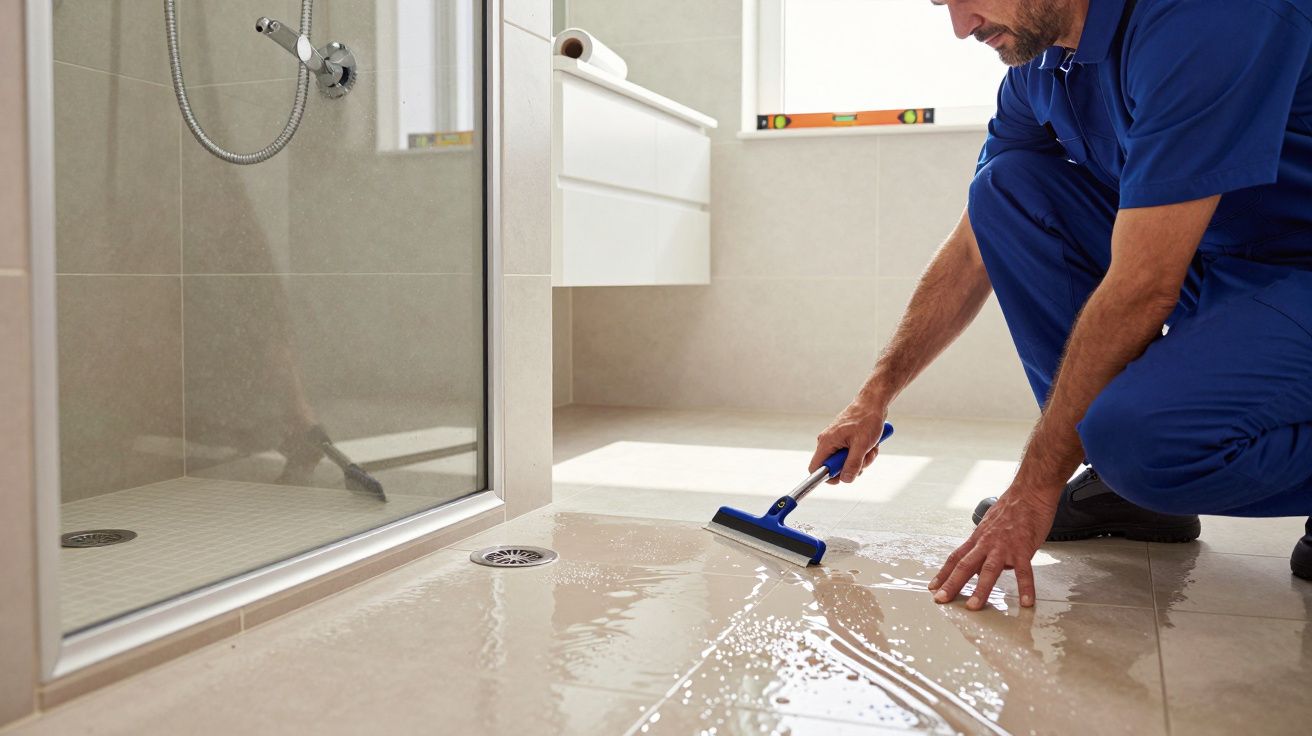
A simple mental check works: after a shower, could you squeegee the whole shower area towards the drain in a few pushes - or would you be pushing it across the room like you’re sweeping a kitchen?
Doors, thresholds, and the myth of the “fully open” wet room
A true open wet room looks stunning. It’s also unforgiving in real homes where people rush, windows stay shut in winter, and towels get hung wherever there’s space.
If you have a bathroom door opening into the room, pay attention to the hinge side and the direction water will travel. The day you realise your towel is wicking water from the floor into the hallway carpet is the day you stop caring how “seamless” it looked on Pinterest.
A small change - like keeping the wettest zone further from the door line, or adding a discreet screen - can be the difference between a wet room that feels premium and one that feels like a perpetual compromise.
A quick “real life” layout checklist
You don’t need to become an engineer. You just need to think like water for two minutes.
- Where does spray land when someone turns and rinses their hair?
- What happens if the drain is partially slowed by soap scum - where does the backup go?
- Is there any direct water route to the doorway, toilet base, or vanity plinth?
- Can the room dry out quickly, or have you created a damp corner that never gets air?
If any answer makes you hesitate, the layout is asking for too much faith.
The simplest layouts that tend to work (and why)
There are a few patterns that show up again and again in wet rooms that stay clean, dry, and low-stress.
- Shower at the far end, drain within the shower zone, fixed screen near the opening. Water stays in one area; the rest of the floor behaves like a normal bathroom.
- Linear drain along the back wall or screen line. It “catches” flow without asking water to travel across the room, and it can make tiling simpler.
- Toilet and vanity on the driest side of the room. Not because they can’t get wet, but because they shouldn’t have to.
The point isn’t to copy a template. It’s to stop water from touring your bathroom twice a day.
What people notice when the layout is right
It’s not that you admire the slope. You just stop thinking about the floor.
You stop stepping around puddles. Towels dry properly. The room smells cleaner because it is cleaner. And you don’t get that low-level anxiety that something is slowly happening behind the tiles.
A wet room should feel like freedom. The layout is what decides whether it actually is.
FAQ:
- Do I need a screen in a wet room? Not always, but a fixed screen is one of the easiest ways to control spray and keep water flow paths concentrated near the drain.
- Where should the drain go in a wet room layout? Ideally, where it captures the bulk of water with minimal travel - usually within the shower zone, not “centrally” for appearance.
- Why does water collect near the door? Falls may be too shallow or aimed the wrong way, or the drain is too far from the shower area, forcing water to cross the room.
- Can I have a completely open wet room and still keep it dry? Yes, but it requires very deliberate falls, strong extraction/ventilation, and careful placement of the shower so spray and runoff don’t head towards the doorway.
- What’s the biggest sign my layout is wrong after installation? Persistent damp corners or repeated puddling in the same spot, especially outside the shower area, usually means the falls and zoning aren’t doing their job.



Comments (0)
No comments yet. Be the first to comment!
Leave a Comment