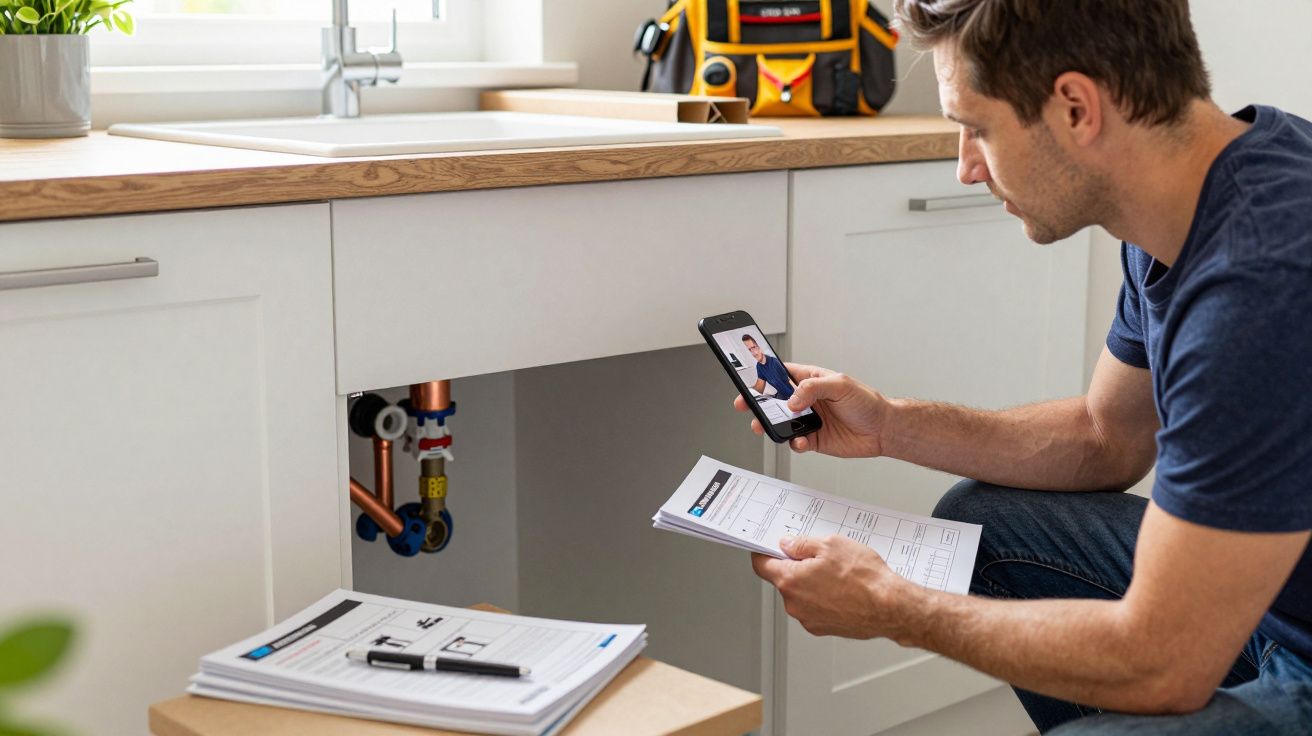
The quickest way to lose cover on a refurb isn’t a cracked tile or a wonky door. It’s plumbing installations done with compliance errors baked in-hidden behind plasterboard, signed off by nobody, and discovered only when something leaks or fails. For homeowners, that matters because warranties and insurance don’t usually fail dramatically; they quietly step aside when the paperwork and standards aren’t there.
It often starts innocently: a “like for like” swap, a rushed kitchen move, or a bathroom update where the pipework is treated as background. Then the boiler trips, the shower pressure drops, or a ceiling stain appears-and the first question isn’t “what broke?”, it’s “was this installed correctly, and can you prove it?”
The mistake: treating plumbing as DIY-adjacent
People think of plumbing as a set of parts you can upgrade as long as it all fits. A new mixer tap, a relocated radiator, an unvented hot water cylinder, a macerator, a pump-how hard can it be if it turns on?
The problem is that warranties aren’t written for “seems fine”. They’re written for traceable installation: correct materials, correct methods, correct safety provisions, and the right person taking responsibility for commissioning and certification. When that chain breaks, the manufacturer and insurer have an easy exit.
A warranty claim rarely fails because the product is “bad”. It fails because the installation can’t be defended.
Where it shows up in real renovations
- Moving a boiler or cylinder and “sorting the pipework later”
- Burying joints in walls or floors without access panels
- Mixing pipe materials and fittings without considering compatibility
- Skipping flushing, inhibitor dosing, or system balancing on heating circuits
- Connecting to the wrong waste/vent arrangement after a layout change
None of these look dramatic on day one. They become dramatic when a part fails and the failure analysis points backwards.
Why warranties care: they’re really policing risk
A warranty is a promise with conditions. Manufacturers assume their kit is installed to spec and used within limits; insurers assume the building work was compliant and competently carried out. Compliance errors tell both parties the risk is unknown.
That’s why “Who installed it?” matters so much. It’s not snobbery; it’s accountability. A competent installer leaves a trail: commissioning records, test results, notifications where required, and clear evidence that safety devices and clearances weren’t guessed.
The quiet deal-breakers hidden in the small print
- Installation not in line with manufacturer instructions
- Work not carried out by a suitably qualified/approved person (where specified)
- No commissioning benchmarks recorded (pressure, flow, combustion, temperature)
- Lack of documentation for safety-critical systems (especially gas and unvented hot water)
- Evidence of alteration after installation (the “my builder tweaked it” problem)
If you can’t produce the record, you’re often treated as if it didn’t happen.
Plumbing installations that attract the harshest scrutiny
Not everything carries the same level of risk, so it doesn’t attract the same level of judgement. The closer you get to scalding risk, combustion risk, or flood risk, the more rigid the expectations.
High-stakes areas homeowners underestimate
- Boilers and gas pipework (safety-critical; strict competency expectations)
- Unvented hot water cylinders (discharge pipework and safety valves must be correct)
- Underfloor heating and hidden manifolds (leaks are expensive, access is essential)
- Soil stacks, waste falls, and venting (bad design leads to smells, blockages, siphoning)
- Whole-house pressure boosting (can stress fittings and appliances if mis-set)
It’s not that other plumbing “doesn’t matter”. It’s that these are the ones where a claim file gets forensic fast.
How to avoid the void: a simple compliance habit
You don’t need to become a standards expert. You need a process that makes compliance the default, not an afterthought.
A practical checklist before anything gets boxed in
- Ask for the installation method statement in plain English: what’s changing, and what stays.
- Keep manufacturer instructions for every major component (PDF is fine).
- Require commissioning evidence: photos of gauges/readings, benchmark sheets, settings.
- Don’t allow concealed joints without agreed access (hatches aren’t “ugly”; they’re insurance).
- Photograph stages: pipe runs, isolation valves, discharge routes, pressure relief terminations.
- Get invoices that clearly describe the work and the installer’s details.
Let’s be honest: nobody loves admin mid-renovation. But this is the kind that pays you back the first time something goes wrong.
The moment claims get decided: “show us the story”
When a component fails, the question becomes: can the failure be separated from the installation? If you can show correct sizing, correct safety devices, correct commissioning, and correct sign-off, you’ve got a story that holds.
If you can’t, you’re left arguing from memory while someone else points to a clause that says “installed contrary to instructions” and closes the case.
The short version to remember
- Products fail. That’s normal.
- Claims succeed when the installation is provably compliant.
- Compliance errors turn a repair into a full-cost problem, fast.
FAQ:
- Does this only apply to boilers? No. Boilers are the most obvious, but pumps, cylinders, underfloor heating, waste systems, and even some taps and valves can have warranty conditions tied to correct installation and commissioning.
- If it works, surely it’s compliant? Not necessarily. Many issues (wrong discharge pipe route, concealed joints, incorrect venting, missing inhibitor) can “work” until they don’t, and warranties often hinge on installation method rather than day-one performance.
- What should I keep as proof? Invoices with clear scope, installer details, commissioning/benchmark records, manufacturer instructions, and staged photos before walls and floors are closed up.
- Can I do parts of the plumbing myself and still keep warranties? Sometimes, but it depends on the product and the nature of the work. If the manufacturer specifies competent/approved installation or commissioning, DIY alterations can weaken or void cover even if a professional later “checks it over.”





Comments (0)
No comments yet. Be the first to comment!
Leave a Comment