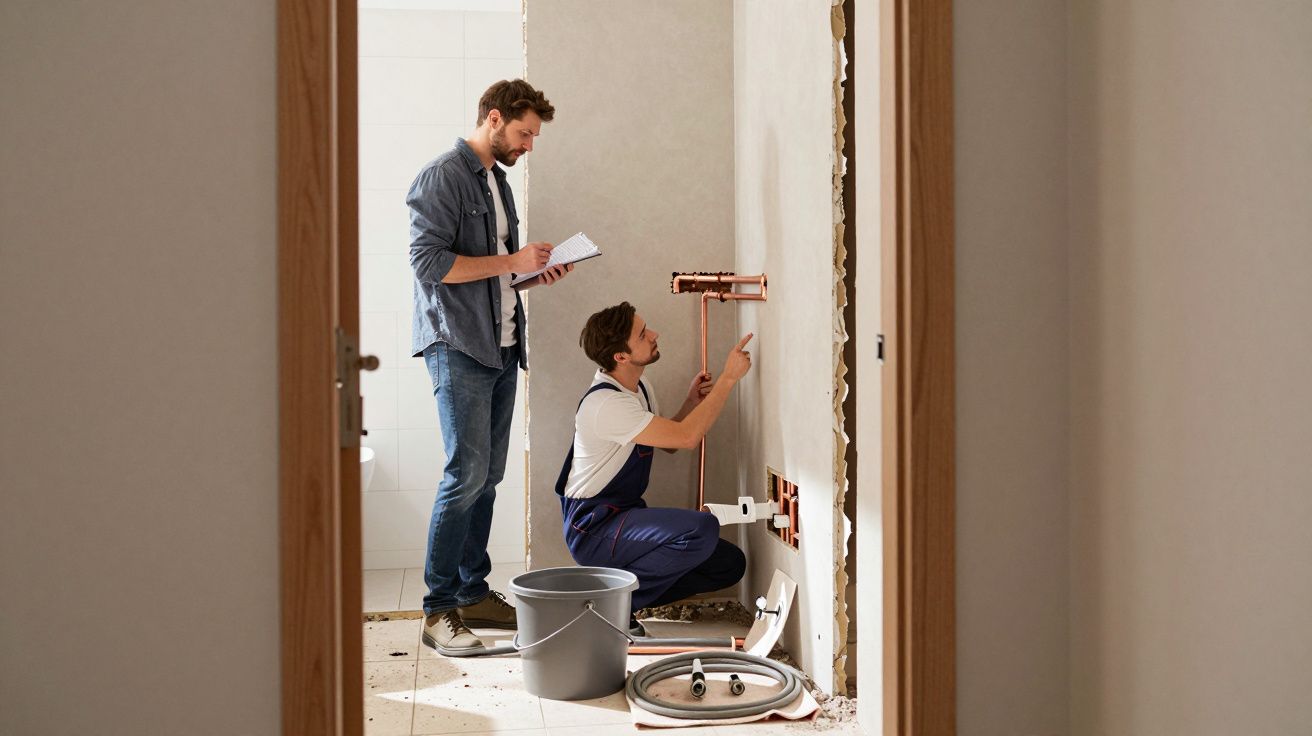
It always starts as a tidy little plan: new tiles, a better shower, maybe a niche for shampoo that makes you feel like an adult. Then someone mentions bathroom plumbing reconfiguration, and suddenly you’re talking about concealed pipe reroutes behind walls you assumed were solid and final. It’s relevant because it’s the one delay that doesn’t look like a delay until the day your fitter says, “We can’t put anything back until we know where the pipes can actually go.”
On a Wednesday that was meant to be “second-fix week”, I stood in the doorway of what used to be my bathroom and looked at a stud wall that wasn’t there on Monday. The bath was out, the floor was a patchwork of old adhesive and dust, and the air had that faint metallic tang of cut copper. Somewhere downstairs, the kettle boiled, and for the first time I realised how much of renovation stress is really just the stress of not being able to wash your hair normally.
The moment the timeline stops being yours
Most delays come with a narrative you can understand. The tiles are backordered. The vanity unit arrived smashed. The electrician is ill. Annoying, yes, but linear. Plumbing reconfiguration isn’t linear; it’s archaeological.
It tends to begin with a hopeful sentence: “We’ll just move the toilet a bit.” That “bit” is the exact point where gravity, pipe falls, joists, and building regs all start having opinions. The job stops being about taste and starts being about physics.
And unlike a late delivery, you can’t solve it by refreshing a tracking link. You solve it by opening things up, finding out what you’ve really got, then redesigning around the truth.
Why concealed pipe reroutes cause the most chaos
There’s a special cruelty to concealed pipe reroutes: they hide in plain sight until you commit. Your bathroom looks ordinary, your plan looks sensible, and then the wall comes off and the house reveals its compromises-odd bends, undersized wastes, pipework that takes the scenic route because someone in 1998 didn’t want to lift a floorboard.
A reroute is rarely just “moving a pipe”. It’s often:
- Repositioning hot and cold feeds so your new shower valve isn’t fighting old pipe runs.
- Correcting waste falls so water actually leaves the room instead of sulking in the pipe.
- Boxing-in or building out walls to accommodate pipe depth and access.
- Chasing channels in masonry (messy) or upgrading to studwork (space-hungry).
- Reworking ventilation routes because everything is suddenly not where it used to be.
Even when the plumber is brilliant, the building itself can be stubborn. Joists don’t move. Stack positions don’t politely shift to suit your Pinterest board. External walls are not forgiving when you ask them to hide a pipe and still insulate properly.
The “we’ll know more once it’s open” tax
This is the part people don’t budget for emotionally. The plan feels agreed-until the first exploratory hole. Then the project runs on a new currency: access.
If your pipes are under a solid floor, behind tiled walls, or threaded through tight joist bays, the work becomes less “install” and more “make room to install”. You pay in time because you’re doing two jobs: creating a route, then fitting the route.
And yes, sometimes you pay twice-because the first route you imagined turns out to be impossible without compromising structure or getting into bigger works than you signed up for.
What it looks like in real life (and why it feels personal)
A friend of mine planned a simple swap: bath out, walk-in shower in, toilet shifted 300mm to centre it on a new wall. She chose fixtures, booked a week off work, and stocked up on those big plastic storage boxes people buy when they’re about to become a “very organised person”.
Day three: the plumber found the soil pipe didn’t have enough fall to take the new toilet position without either raising the floor or rerouting to the stack via a bulkhead. Raising the floor meant a new threshold at the door and a weird step. The bulkhead meant sacrificing the clean line of her new vanity wall.
Neither option was in the moodboard. Both were real.
By the end, her bathroom looked great. But the delay came from the in-between week: decisions, redesign, extra materials, extra labour, and the quiet misery of brushing your teeth in the kitchen while pretending you’re “fine, honestly”.
How to plan for the delay without catastrophising
You can’t plan every surprise, but you can stop pretending plumbing is an afterthought. The goal isn’t to eliminate risk; it’s to stop the risk from taking your whole calendar hostage.
Here are the moves that make the biggest difference:
- Get a plumber involved before you finalise the layout. Not after you’ve bought everything. A 20-minute “can this actually work?” chat is worth more than a thousand saved Instagram posts.
- Assume walls and floors will need opening. If you’re in an older UK property, treat access as a line item, not a freak event.
- Build a decision buffer into your schedule. Not “we finish Friday”. More like: “We do first-fix, then we have two days for whatever reality says next.”
- Have a Plan B layout you can live with. Especially for toilet position and shower waste location. Your dream is lovely; your stack is not sentimental.
- Ask about future access. Concealed doesn’t mean “sealed forever”. Panels, removable boxing, and sensible shut-offs save you later.
Let’s be honest: most of us plan renovations like we’re ordering a new sofa. Plumbing is not a sofa. It’s a system with rules, and when you change one part, the whole thing responds.
The hidden “second delay”: drying time
Even when the pipes are finally where they need to be, there’s another pause people don’t respect until they’re forced to. Once you’ve chased walls, laid screed, tanked a shower area, or patched floors, you’re suddenly waiting for materials to dry and cure properly.
This is where the domino effect lands. Waterproofing needs time. Adhesives need time. Plaster needs time. If you rush it, you don’t just risk a messy finish-you risk leaks behind your brand-new tiles, which is the sort of irony that can break a person.
A practical rule is to ask each trade, plainly: “What needs drying time here, and how long are we actually waiting?” Then write that into the sequence like it matters, because it does.
A quick reality checklist before you move anything
If you’re about to change the layout-even slightly-these questions save the most pain:
- Where is the soil stack, and how far is the new WC from it?
- Can the waste pipe maintain the correct fall without raising the floor?
- Are you on suspended timber or solid concrete? (It changes everything.)
- Do you need concealed valves, and can you access them later?
- Will any reroute require drilling/notching joists, and is that allowed?
- Are you moving a shower waste, and is there depth for a trap?
If you don’t know the answers, that’s not failure. It just means your “simple renovation” is actually a small engineering project, and it deserves a bit of pre-work.
The calm way to think about it
The real renovation delay nobody plans for isn’t a late delivery or a flaky contractor. It’s the stretch of time where your bathroom becomes a question mark because the house won’t confirm what’s possible until it’s opened up.
If you plan for bathroom plumbing reconfiguration as a likely chapter-not a rare disaster-you get to stay calmer when concealed pipe reroutes appear on the whiteboard. You’ll still be inconvenienced. You’ll still miss your own shower. But you won’t be blindsided by the part where the build stops being about style and starts being about what your home can physically support.
And when it’s done, and the water runs where it should, you’ll know you didn’t just buy a nicer bathroom. You earned a quieter kind of confidence: the sense that your house is now telling the truth behind the walls.




Comments (0)
No comments yet. Be the first to comment!
Leave a Comment