You don’t expect emergency plumbing to feature in the aftermath of the renovation, but it often does-right when the dust sheets are gone and the kettle is back on the worktop. It matters because the most expensive leaks aren’t the dramatic ones you spot immediately, but the quiet failures that start small and travel through ceilings, joists and freshly painted walls.
A refit changes how water moves through a home. Pipes get nudged, wastes get re-angled, old stopcocks get left half-stiff behind new cupboards, and “temporary” caps become permanent by accident. Weeks later, the first proper test arrives: a full house, a hot shower, a washing machine cycle, and someone turning on the garden tap.
The call that comes after the ‘finished’ photo
Most renovation emergencies don’t happen during the work. They happen when normal life returns and the plumbing is used the way it’s meant to be used: simultaneously, repeatedly, and without anyone watching for drips.
A common pattern looks like this. The bathroom has been moved, the kitchen has new units, and the heating has been drained and refilled at least once. Everything seems fine until the first evening you run the dishwasher while someone showers and the downstairs loo gets flushed.
The problem isn’t that builders “can’t plumb”. It’s that small compromises made to get a job over the line can turn into weak points once the system is under everyday load.
What actually fails (and why it’s not always the new bit)
People assume the shiny new fixture is the culprit. In practice, the failure point is often a join that was touched, stressed, or reassembled-especially where old meets new.
Typical post-refit triggers include:
- A slightly misaligned compression joint that held during a brief test, then weeps under vibration from appliances.
- A waste pipe with poor fall that drains “well enough” until grease, plaster dust, and hair combine into a slow blockage.
- A stop tap that hasn’t been exercised for years, forced shut in a rush, then won’t fully re-open (or won’t fully close when you need it).
- New silicone over old movement, where a bath or tray flexes and breaks the seal weeks later.
- Debris in the system after a drain-down-bits of scale and sludge lodging in taps, shower valves, pumps, and combi filters.
The annoying truth is that a refit can be perfectly competent and still leave a home more vulnerable for a while. Things have been disturbed, and disturbed systems reveal their weak points in stages.
The slow leak that behaves like a mystery
The emergency call nobody links to refits is the one that starts as a smell. Or a faint stain. Or a single swollen bit of skirting you blame on “winter damp”.
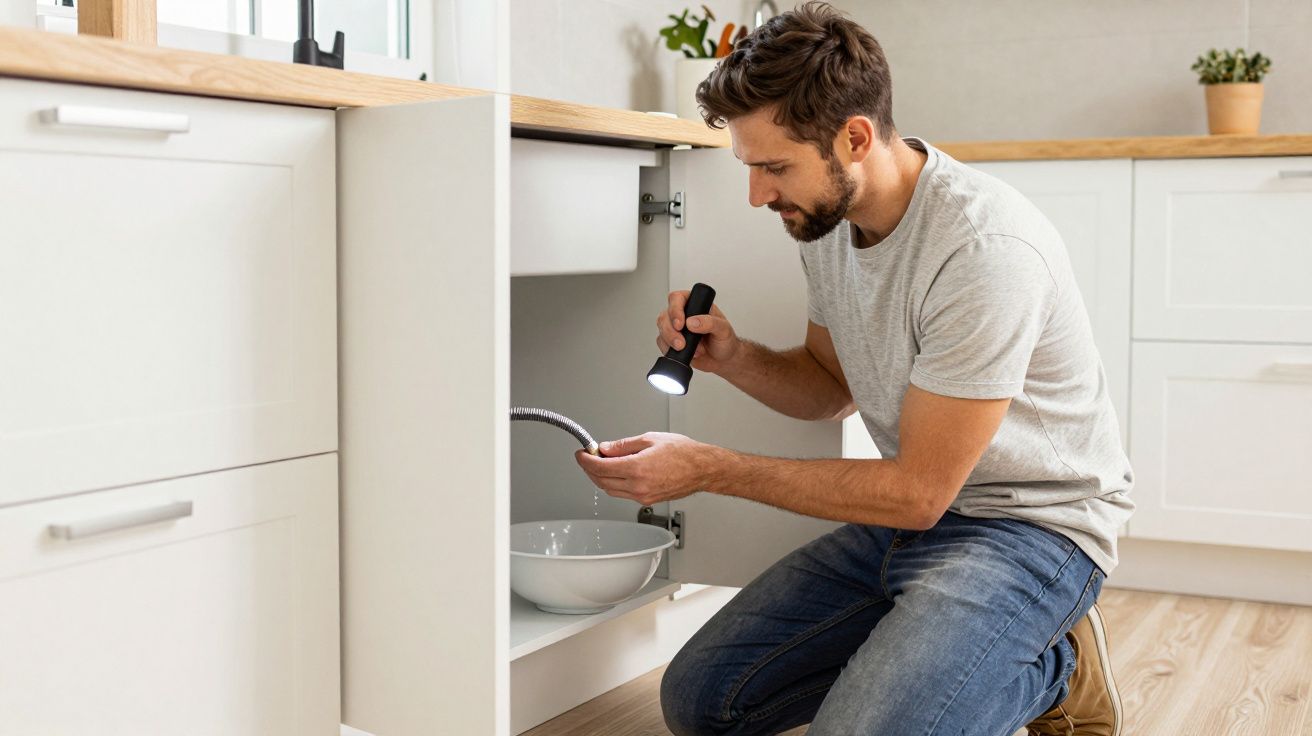
A small leak under a new kitchen sink is rarely cinematic. It’s a fine bead forming on a valve body, a slow drip off a flexi hose nut, or a waste connection that only seeps when the bowl is full and released. Water then tracks along the underside of units, finds screw holes, wicks into chipboard, and shows up somewhere else entirely.
If you’ve just renovated, take seriously:
- A cupboard base that feels spongy or looks darker at the edges
- Paint bubbling near a ceiling line below a bathroom
- A musty odour that persists after cleaning
- Flooring that lifts at a seam with no obvious spill
These are not “wait and see” signals. They’re early warnings that your property is absorbing water where you can’t see it.
First response: what to do before the plumber arrives
In a true emergency, you’re buying time and limiting spread. The goal is not to diagnose perfectly; it’s to stop water and document what you can.
- Shut off the water at the stop tap (usually under the kitchen sink, hallway cupboard, or by the meter). If it won’t turn, don’t force it to snapping point-go for the external stop tap if you have one.
- Turn off electrics to affected areas if water is near sockets, light fittings, or the consumer unit. If in doubt, call your electricity network operator for advice.
- Relieve pressure by opening cold taps on the lowest floor after shutting the supply.
- Contain and protect: towels, a bucket, and moving valuables beats hunting for the “right” tray.
- Take photos of the source area, any visible joints, and any staining. It helps later with insurers, warranty arguments, and sorting what was actually changed.
If the leak is from heating (not mains), isolate the boiler and topping-up loop. A heating leak can still cause major damage, but the pressure and response steps differ.
Why the timing is so predictable
Renovations often involve a long chain of small decisions: a new sink position means new waste routing; that means a different trap; that means pushing a supply pipe slightly; that means a join hidden behind a unit. Each step is minor, but hidden joints don’t get rechecked once the cupboards go in.
And then there’s behaviour. During works, you might be using fewer fixtures, less often, and at odd times. Once the house is back to normal, the system gets its first real stress test.
The “three loads” moment
Many plumbers recognise the same story: everything was fine until the weekend.
- First: a long shower after the gym
- Second: a washing machine cycle
- Third: the dishwasher, because you’re finally unpacked
That combination pushes both supply and waste. A marginal waste fall becomes a slow overflow. A slightly loose nut becomes a steady drip. A newly boxed-in pipe warms and expands with hot water, then cools and contracts, and the joint moves just enough to start weeping.
Prevention that takes 30 minutes, not a whole new project
You can’t eliminate risk, but you can catch the obvious weaknesses early-especially in the first month after a refit.
A practical post-renovation check looks like this:
- Run every tap hot and cold for a minute while watching the cabinet internals with a torch.
- Fill and release each basin and sink while checking waste joints and overflows.
- Flush every toilet several times; watch the pan-to-soil connection and the cistern feed.
- Check the washing machine and dishwasher hoses at the valve end and the appliance end.
- Locate and test the stop tap gently: close and reopen to confirm it moves and doesn’t leak from the spindle.
If you’ve had bathrooms moved or pipework altered, do the check again after a week of normal use. Problems often start once materials settle.
When emergency plumbing is the right call (and when it isn’t)
Not every drip is an emergency, but after a renovation you should be stricter than usual because water can reach new voids-fresh boxing, new flooring layers, newly plastered walls-and cause damage faster.
Call emergency plumbing if:
- You can’t isolate the leak quickly
- Water is affecting electrics or coming through ceilings
- The leak rate is more than a slow drip
- A toilet is overflowing or a soil connection is compromised
- You suspect a hidden leak (staining, swelling, persistent damp) with no visible source
If it’s a contained, visible weep you can isolate and dry, you may be fine booking a standard visit. The key is isolation plus certainty: if you don’t have both, treat it as urgent.
The awkward question: is it the renovation’s fault?
Sometimes it is. Sometimes it isn’t. Renovations can expose older weaknesses that were already there: corroded pipework, tired valves, brittle waste fittings. The timing makes it look like blame, but the underlying issue may have been waiting for any disturbance.
What helps-without turning your home into a courtroom-is keeping a simple record:
- What was changed (photos before cupboards and boxing go in are gold)
- Product manuals and installation dates
- Any pressure tests or sign-off notes
- Warranty details for fittings and workmanship
That paper trail doesn’t create conflict; it prevents confusion when you’re trying to work out whether you’re calling the fitter, the manufacturer, your insurer, or an independent plumber.
FAQ:
- Should I switch off the water every night after a renovation? Not usually, but for the first few days-especially if pipework has been moved and joints are hidden-it can be a sensible precaution if it’s easy to do and the stop tap works smoothly.
- Is a damp patch always a leak? No. Fresh plaster, poor ventilation, and cold bridging can mimic leaks. But after a refit, assume it’s plumbing-related until you rule it out, because the cost of ignoring a leak is far higher.
- What’s the most common post-refit leak point? Under-sink connections: isolation valves, flexi tails, and wastes. They’re frequently disturbed, often hidden, and used many times a day.
- Can I just seal around it with silicone? Silicone can hide symptoms while water continues behind fittings. If the source is a joint or failed connection, it needs tightening, re-making, or replacing-not covering.





Comments (0)
No comments yet. Be the first to comment!
Leave a Comment