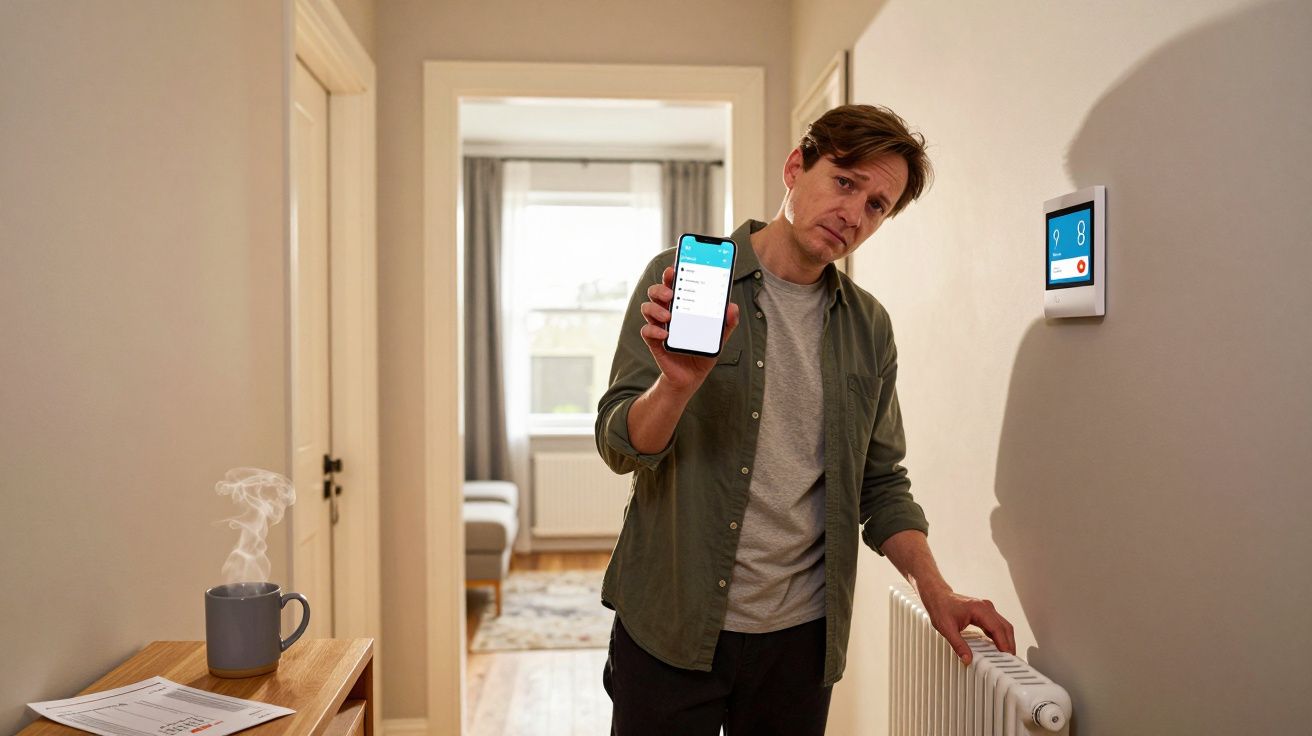
You notice it on a damp Tuesday evening: the radiators are cold, the house feels oddly muggy, and everyone is blaming everyone else. Smart thermostats were meant to make heating simpler and cheaper, yet control misconfiguration in the app, the schedules, or the radiator valves often creates fresh comfort problems that feel harder to explain than “turn it up”. If you live in a UK home with mixed routines-school runs, WFH days, shift work-those small settings can decide whether the place feels calm or constantly “not quite right”.
It’s rarely that the kit is broken. It’s that the system is doing exactly what you asked-three menus ago, on a Sunday afternoon, when you were trying to be sensible about bills.
Why smart heating feels clever-until it meets real life
Smart thermostats sell a neat promise: heat rooms only when needed, learn your habits, and shave off wasted energy. In a predictable household, that can work well. In a normal household, “predictable” lasts about ten minutes.
A teenager comes home early, someone stays up late with a deadline, a parent is ill and sits still all day. The heating plan that looked efficient on a graph can suddenly feel punishing in the body: cold hands in the spare room office, a bedroom that never quite warms up, a living room that peaks at the wrong time.
Comfort is not a single temperature. It’s timing, humidity, airflow, and the unglamorous reality that people use different rooms for different lengths of time.
The quiet culprit: control misconfiguration
Most comfort complaints trace back to a few repeat errors. They’re easy to make because smart thermostat apps encourage “set and forget”, while houses demand “set and revisit”.
Typical misconfigurations include:
- Over-tight schedules that assume everyone leaves at 8:30 and returns at 6.
- Conflicting controls (thermostat, boiler programmer, smart TRVs) all trying to be the boss.
- Wrong room assumptions, such as placing the main thermostat in a hallway that warms quickly, so the rest of the house stays chilly.
- Aggressive setbacks (dropping to 14–15°C) that save some energy but make recovery slow and uncomfortable, especially in older, draughtier homes.
- Geofencing that half-works, turning heating off because one phone left the house while someone else stayed in.
You experience it as “the heating has a mind of its own”. The system experiences it as “I followed the rules”.
A familiar UK scenario: the warm lounge, the frozen back room
Picture a semi where the thermostat sits near the stairs, catching heat from the kitchen and the afternoon sun. The smart schedule says 18°C until 5 p.m., then 20°C for the evening. Meanwhile the person working in the back bedroom is in a hoodie at 3 p.m., because that room never gets the signal that comfort has become urgent.
At 6 p.m., the lounge hits target quickly and the system eases off. The back room finally climbs-just as it’s no longer needed. By bedtime, the bedrooms are either too warm to sleep well or too cold to get out of bed without resentment.
This is how “efficiency” can feel like discomfort: the heat arrives, but not where you are.
The three controls you should simplify first
Before chasing clever automations, make the basics boring again. You want one clear chain of command, not a committee.
- Choose the boss. If the smart thermostat controls the boiler, disable any old timer/programmer schedules or set them to always-on.
- Pick your reference room. The thermostat’s location should reflect where you want comfort most consistently-not the quickest-to-warm spot.
- Tame TRVs. Smart radiator valves are powerful, but only if they match the thermostat strategy. Avoid having every room “call for heat” unless you understand how your system responds.
A useful rule: if you can’t explain why the boiler is firing, the system is too complicated for everyday life.
Small settings that make a big difference (without losing savings)
You don’t need to abandon smart thermostats to regain comfort. You need to reduce surprises.
- Soften the setback: try 16–17°C overnight or when “away”, especially in older properties. The house recovers faster and feels less damp.
- Use fewer time blocks: morning / day / evening is often enough. Micro-schedules look efficient but break as soon as plans change.
- Add a “working from home” toggle: one button that holds a stable temperature for a few hours beats constant manual overrides.
- Check sensor bias: if the thermostat reads warm because it’s near a radiator or in a sunny spot, move it (or use a remote sensor if supported).
- Beware of open-window detection: great in theory, annoying in practice if it triggers from quick ventilation and then refuses to recover.
The goal is not perfect automation. It’s fewer moments when you’re cold and can’t work out why.
Quick diagnostic: match the complaint to the likely cause
| What you feel | Likely cause | Quick fix |
|---|---|---|
| “The lounge is fine, but the office is freezing.” | Thermostat in a warm spot; TRVs not aligned | Move sensor / raise office TRV target during work hours |
| “It heats up too late, then overshoots.” | Schedule too tight; aggressive setback | Start earlier by 30–60 mins; raise setback temp |
| “It keeps turning off when someone’s home.” | Geofencing based on one phone | Use multi-user presence or disable geofence |
When “learning” features learn the wrong lesson
Learning algorithms sound comforting: the system watches what you do and adapts. The problem is that many households don’t have a stable pattern, and the system interprets your overrides as preferences rather than exceptions.
If you boost the heating three cold mornings in a row, some systems assume that’s the new normal. Then a milder week arrives and the house feels stuffy, so you lower it. Now it’s learnt the opposite. You end up in a small tug-of-war with a device that is trying to be helpful.
A calmer approach is to treat learning as optional. Use it once your schedule is broadly correct, not as a substitute for it.
The human bit: comfort is shared, not averaged
Heating arguments are rarely about numbers. They’re about who gets listened to, who gets up first, who sits still all day, and who pays the bill. Smart controls can make that worse because they hide the decision-making behind menus and “eco” labels.
A 10-minute household check-in can prevent weeks of silent shivering:
- Agree one baseline comfort temperature for occupied hours.
- Agree one sleep temperature (often lower, but not punitive).
- Decide which room gets priority (often the home office or living room).
- Pick one person to own the settings, with a monthly review.
Multiplayer homes need simple rules. Otherwise the cleverest device becomes another thing to negotiate.
FAQ:
- Do smart thermostats actually save money? Often yes, especially if you’re coming from “always on” habits, but savings shrink if comfort problems lead to constant boosts and overrides.
- Should I use smart TRVs in every room? Not necessarily. Start with the rooms that genuinely need different temperatures (e.g., office and bedroom) and keep the rest simple until the system feels predictable.
- Why does the house feel clammy even when it’s warm enough? Temperature is only part of comfort; large swings and low baseline temps can increase damp and slow drying. A slightly higher setback and steadier schedule often helps.
- Is geofencing worth it? It can be, but only if everyone’s presence is tracked reliably. In busy households it’s often safer to use time blocks plus an “away” button.
- What’s the quickest way to fix comfort without fiddling all week? Reduce schedules to three blocks, soften the setback to 16–17°C, and make sure only one device is truly controlling the boiler.





Comments (0)
No comments yet. Be the first to comment!
Leave a Comment