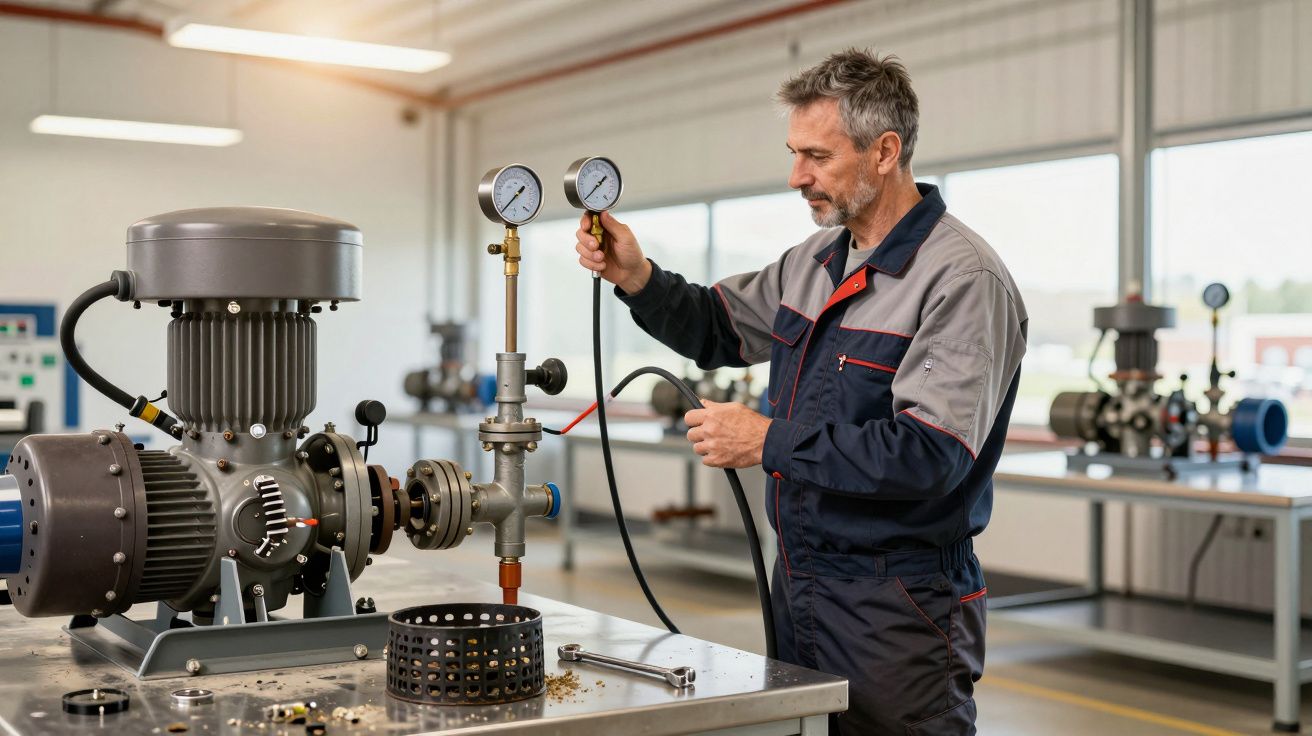
A maintenance engineer stands beside a humming pump skid, one hand on the pipework, the other on a pressure gauge that won’t sit still. The plant looks calm, but the system pressure balance is already off, and progressive failure has started its quiet work in the background. If you run HVAC, water, steam, compressed air, hydraulics, or any circulating loop, this matters because the first symptom is rarely dramatic-yet the end result can be.
You don’t get a bang. You get “little things”: a valve that hunts, a pump that sounds rough on Mondays, a filter that clogs faster than it used to, a room that never quite reaches setpoint. The system adapts until it can’t.
The imbalance people ignore (because the system still “runs”)
Pressure balance isn’t a nice-to-have. It’s the condition that keeps flow stable, keeps control valves in their working range, and keeps components from being forced into roles they were never sized for.
When it slips, the system often compensates in ways that look like success:
- A pump ramps up to cover a restriction.
- A controller opens a valve further to chase flow.
- An operator raises a setpoint “just to get through the day”.
Those moves can restore output in the short term, but they also hide the real issue. The more you compensate, the more you shift stress onto seals, bearings, heat exchangers, hoses, and joints. That’s how progressive failure becomes normalised: not as one big mistake, but as a series of small “reasonable” adjustments.
How one pressure mistake turns into a chain reaction
Most pressure problems don’t stay in one place. Pressure is a system-wide signal, and the moment it’s wrong, everything downstream starts making bad decisions.
A common pattern looks like this:
- A restriction appears (partially closed valve, fouled strainer, scaling, stuck damper, pinched hose, saturated filter).
- Differential pressure rises across that restriction, and available pressure elsewhere drops.
- Controls begin to hunt because the actuator is no longer operating in its stable range.
- Vibration and cycling increase, which loosens fittings and accelerates wear.
- Debris spreads (seal fragments, corrosion, shed scale), creating new restrictions and sticking components.
- The “fix” becomes permanent (higher pump speed, higher compressor discharge pressure, higher boiler firing), and energy use climbs.
None of this requires a single catastrophic event. It just requires one imbalance to be left in place long enough to train the system into bad habits.
The system rarely fails where the original problem started. It fails where the compensation finally runs out.
The tell-tale signs that it’s not a component problem
People often replace the noisy part and feel relief. Then the replacement starts failing too, because the imbalance is still there.
Look for these patterns:
- Repeat failures in different brands of the same part (seals, bearings, PRVs, solenoids).
- Valves that live near fully open or fully shut instead of modulating smoothly.
- Unstable readings: pressure that oscillates, flow that won’t hold, temperature swings that don’t match load.
- Unexplained energy creep: same production, higher kWh; same occupancy, higher gas.
- Fast fouling: strainers that suddenly need weekly attention, filters that “should last a month” lasting ten days.
These are system behaviours. Treating them as isolated component defects is how you end up paying for the same failure repeatedly, just in different forms.
Where pressure balance typically breaks first
The weak spots are rarely the impressive ones. It’s usually a transition, an edge, or a “temporary” modification that became permanent.
Check these before you order new kit:
- Bypasses and partially shut isolation valves left after maintenance.
- Dirty strainers and undersized filters that slowly become permanent restrictions.
- Incorrectly set pressure-reducing valves or failed regulators drifting high/low.
- Expansion vessels / accumulator charge issues, causing rapid cycling and shock.
- Air ingress in closed loops (microbubbles) reducing pump performance and driving corrosion.
- Bad sensor placement or drift causing controls to fight ghosts.
A pressure gauge that reads “about right” at one point doesn’t prove balance. Balance is about relationships-upstream/downstream, supply/return, suction/discharge, and the differential across critical components.
A quick way to diagnose it without tearing everything apart
You don’t need a full redesign to locate an imbalance. You need a consistent method and a willingness to measure before adjusting.
Start simple:
- Pick three points: upstream of the problem area, downstream of it, and at the pump/compressor discharge.
- Record readings at two conditions: low load and high load. A system that only misbehaves under demand is still misbehaving.
- Look for “pinch points”: places where differential pressure climbs sharply compared to baseline.
- Watch the control response: does a valve move a lot for little result? Does a VSD ramp hard but flow barely changes?
If you can only do one thing this week, do this: measure differential pressure across the most likely restriction (strainer, heat exchanger, filter bank, coil). It’s the closest thing to an X-ray you can do with basic tools.
What “good” often looks like in practice
Not perfect numbers-stable behaviour.
| Observation | What it suggests | Why it matters |
|---|---|---|
| Stable differential under steady load | Healthy flow path | Controls stay calm; wear stays low |
| Rising differential over days/weeks | Fouling or restriction forming | Early warning before failures cascade |
| Large oscillations in pressure/flow | Control hunting or air/charge issue | Cycling kills components quietly |
Fixing the cause, not the symptom
Restoring system pressure balance usually means undoing the compensations that have become normal, one by one, while proving stability with measurements.
A sensible order is:
- Remove restrictions first: clean strainers, verify dampers/valves, clear clogged exchangers and filters.
- Confirm regulator and relief settings against design intent, not folklore.
- Re-establish proper charge in expansion vessels/accumulators and bleed air properly where relevant.
- Only then tune controls so valves modulate in their stable mid-range, and drives don’t surge to mask issues.
- Finally, review sizing if the “fix” requires permanent extremes (always max speed, always wide open).
The emotional trap is wanting the noise to stop today. The practical win is preventing the next six months of “random” faults that are anything but random.
From “fine” to stable: the quiet payoff
When pressure balance is restored, the system feels almost boring. Pumps sound smoother. Valves stop chattering. Alarms stop arriving in clusters. Energy use stabilises, not because you installed magic equipment, but because you stopped forcing the system to fight itself.
You also gain something harder to measure: confidence that when a part does fail, it’s likely a real end-of-life event-not the system sacrificing components to cope with a hidden imbalance.
FAQ:
- How do I know it’s pressure imbalance and not just an ageing pump? If you see repeated component issues, unstable control behaviour, or rising energy use, suspect the system first. A dying pump can be real, but it often dies faster when it’s compensating for restrictions or bad control ranges.
- Can a small restriction really cause progressive failure? Yes. A partially blocked strainer or mis-set regulator changes differential pressure, which drives hunting, cycling, vibration, and heat-all of which accelerate wear across multiple components.
- Is it safe to “turn up the pressure” to get performance back? It can restore output temporarily, but it usually increases stress and masks the true fault. Measure differentials and remove restrictions before raising setpoints.
- What’s the fastest measurement that gives real insight? Differential pressure across the suspected restriction (filter, strainer, coil, exchanger) at low and high load. Trending it over time is even better.
- Do I need a full commissioning exercise to fix this? Not always. Many fixes are targeted-cleaning, setting verification, correct charging/bleeding, and modest control retuning-done in a measured sequence.






Comments (0)
No comments yet. Be the first to comment!
Leave a Comment