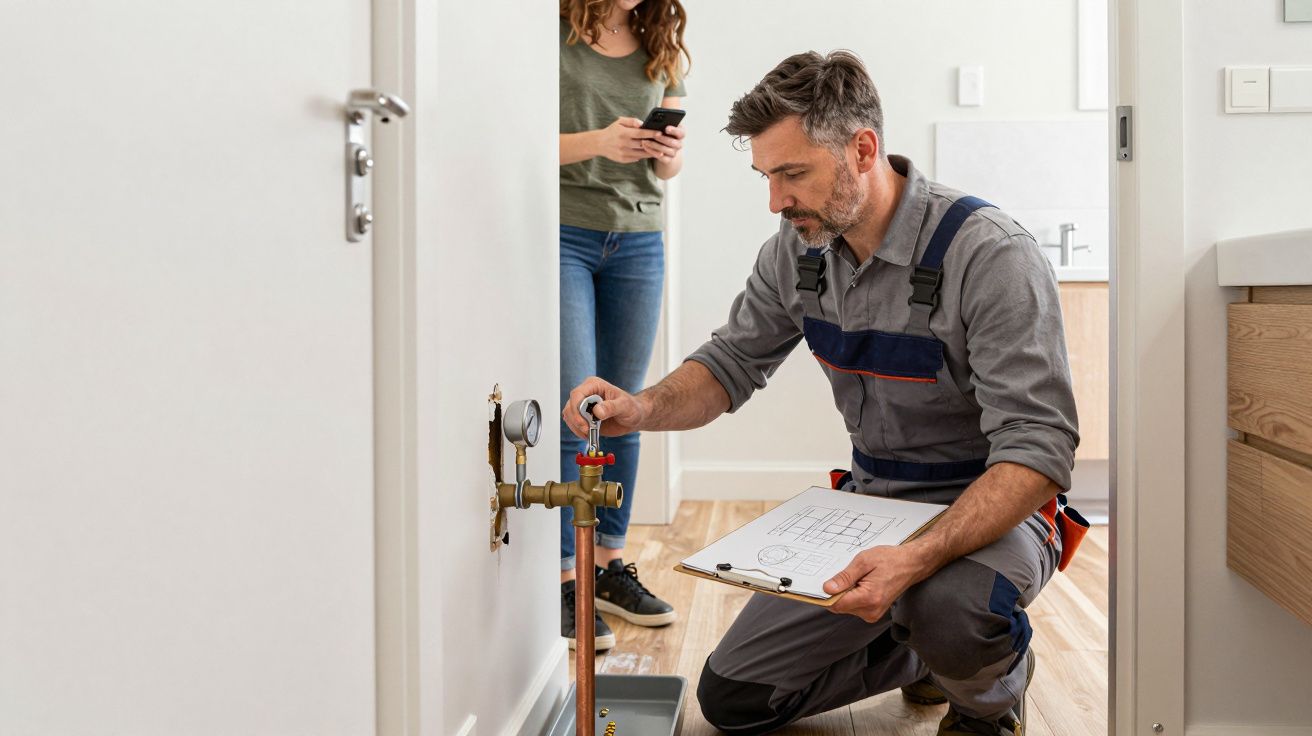
I’m stood in the doorway of a half-stripped terrace in Manchester, watching an engineer do the least dramatic thing imaginable: he doesn’t touch a spanner. He opens a notebook, asks for the drawings, and starts plumbing project planning with a quick risk assessment, because that’s what stops a “simple refit” turning into a flood, a delay, or a wall that has to come down twice.
The client wants a new bathroom and a moved kitchen sink. The builder wants to crack on. The engineer wants one thing first: to spot what will fail when the system is disturbed-because plumbing rarely breaks when it’s static. It breaks when you change it.
The thing engineers look for first: where the water will go when it goes wrong
Refits don’t usually fail because a pipe can’t be fitted. They fail because nobody mapped the weak points and the shut-offs before cutting in. An old isolation valve that “should” turn might not. A hidden dead leg might feed a mystery spur. A waste might be relying on a bodge that’s been fine for ten years-until you move the load.
So engineers scan for three realities that don’t show on mood boards:
- Control points: where you can actually isolate hot, cold, and any secondary circuits.
- Vulnerable fabric: floors, ceilings, and party walls that won’t forgive a drip.
- Pressure and flow constraints: what the existing system can truly deliver, not what it delivered on a good day.
That’s why the first question is rarely “where do you want the taps?” It’s “what’s your stopcock like, and does it move?”
What a practical risk assessment looks like on a refit (not paperwork theatre)
On a small job, “risk assessment” can sound like a binder you’ll never read. On a plumbing refit, it’s often five minutes that saves five days. The point isn’t to predict every scenario; it’s to identify the ones that hurt most: uncontrolled water, uncontrolled heat, and uncontrolled access.
A decent on-site pass usually covers:
- Isolation test: locate the internal stop tap, check it operates, and confirm it actually stops flow.
- Condition check: visible corrosion, verdigris on compression fittings, weeping joints, seized valves.
- Materials and compatibility: copper-to-galvanised transitions, old lead runs, plastic with unknown insert history.
- Access routes: where pipework can run without notching the life out of joists or boxing-in every serviceable joint.
- Waste and fall: whether the new layout can maintain fall without raising floors or creating slow-draining traps.
If any of those are uncertain, the “refit” isn’t a single job anymore. It becomes a small sequence: make safe, prove, then change.
The silent budget-killer: assumptions about what’s behind the wall
Everyone has a mental picture of their plumbing. It’s usually wrong.
In a 1930s semi, you might find a newer kitchen branch tied into an old run with no proper isolation. In a flat conversion, you might find shared services, awkward shut-offs, and pipework that takes the scenic route through someone else’s ceiling. In a Victorian terrace, you might find pipe sizes and layouts that have been “improved” by three different eras of DIY.
Engineers look for clues before they open anything up:
- Patch repairs and odd boxing (a sign of previous leaks or reroutes).
- Warm spots on walls or floors (pipes where you didn’t expect them).
- Mixed fittings and different pipe diameters on the same line.
- Taps that surge or spit (air ingress, poor venting, or pressure issues).
It’s not about being cynical. It’s about treating the unknown as a cost centre until you’ve seen it.
“The refit that goes off the rails is the one that starts with confidence and no confirmation,” one site engineer told me. “Prove the services, then commit.”
The planning moves that make the install smoother (and the call-backs rarer)
Good plumbing project planning isn’t more drawings. It’s fewer surprises. Engineers tend to lock down a handful of decisions early that everyone else is tempted to leave “until later”.
Here are the ones that actually matter:
- Define isolation strategy per fixture, not just “there’s a stopcock somewhere”.
- Agree the pipe routes in three dimensions (up, across, down) so you’re not improvising around steelwork or joists.
- Confirm hot water generation and pressure before choosing outlets, mixers, and showers.
- Plan commissioning and flushing, especially if you’re cutting into older systems.
- Decide what gets replaced as a matter of prudence, not only what is visibly broken.
That last one is the grown-up moment: if a valve is seized today, it won’t be friendlier tomorrow. If pipework is green and pitted, it’s already telling you what the next leak will be.
The “two-minute checks” engineers do that homeowners rarely think to ask for
These aren’t glamorous, but they’re the difference between a neat refit and a panicked night with a wet vac.
- Stop tap and meter check: if the stop tap doesn’t fully shut, fix that before anything else.
- Static and dynamic pressure reading: what you have at rest vs under flow. It changes everything.
- Hot water recovery reality check: cylinder size, boiler output, or combi limitations against your new demand.
- Waste test with a full bowl: a slow waste often shows itself only under volume, not a quick trickle.
- Leak path thinking: if a joint weeps, which ceiling gets it first?
People assume leaks announce themselves. Often they don’t. They soak insulation, track along joists, and appear three metres away.
The traps to avoid when “it’s only a refit”
The most expensive mistakes in refits are usually social, not technical. Somebody didn’t want to be the one to slow things down.
Avoid these classics:
- Starting strip-out without proving isolation (or without a back-up isolation plan).
- Burying joints that need future access, especially on flexi tails and valves.
- Upgrading outlets without upgrading supply, then wondering why the shower is disappointing.
- Ignoring building fabric constraints, then discovering you can’t run that pipe without structural pain.
- Skipping documentation, so the next person cuts into a live line because “it must be dead”.
If you want a simple rule: anything you can’t isolate, you should be able to drain safely. Anything you can’t drain safely, you should be able to access.
| What engineers spot early | Why it matters | Quick action |
|---|---|---|
| Isolation that doesn’t isolate | Prevents safe work; turns minor leaks into incidents | Test/replace stop tap and key valves first |
| Uncertain pipe routes and materials | Hidden risks: mixed metals, old repairs, shared services | Trace, expose small sections, confirm before committing |
| Pressure/flow mismatch | New fittings won’t perform; complaints and rework | Measure dynamic pressure; specify accordingly |
A calmer way to start: plan for water, not just for fittings
A refit feels like choosing taps and tiles. Engineers start with where water comes from, where it goes, and what happens when it escapes. That’s not pessimism; it’s competence.
If you’re hiring trades, ask for the boring bits upfront: “Show me how you’ll isolate it, how you’ll pressure test, and what you’ll replace preventatively.” The answers will tell you more about the outcome than any brand of brassware ever will.
FAQ:
- What’s the first thing I should ask before a plumbing refit starts? Ask how the system will be isolated (stop tap, local valves) and whether those points have been tested to actually shut off flow.
- Do I really need a risk assessment for a domestic refit? Yes. Even a lightweight risk assessment helps identify high-impact failures (no isolation, hidden pipework, pressure limits) before work creates them.
- Why do engineers measure pressure and flow before choosing taps and showers? Because outlet performance depends on dynamic pressure and available flow. Choosing fittings first can lock you into disappointing results or extra upgrades.
- What’s a common “hidden” issue in older UK homes? Seized valves and undocumented reroutes. Both can turn a tidy change into an emergency if you can’t control the water quickly.
- When is it sensible to replace pipework rather than connect into it? When it’s visibly degraded, poorly accessible, or part of a system with mixed materials and unknown history-especially if it will be boxed in after the refit.





Comments (0)
No comments yet. Be the first to comment!
Leave a Comment